Learn what every symbol on the card means.Full credits and sources at beakbrain.com/symbols
 MarinePlatform nestHuge · 2.5 kg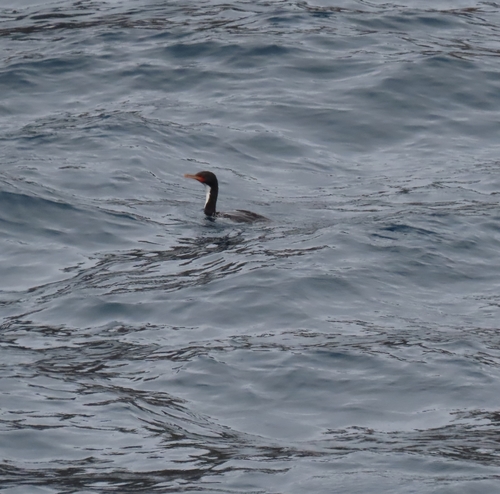


ID tip
Size; 71 cm (28 in). Large, black-and-white cormorant. Black head, hind neck, lower back, rump, uppertail-coverts, all with metallic blue sheen. White underparts. Pink feet. White patches on wings appear as bar when folded. Caruncles absent. Voice: Male makes call during displays only. IUCN classifies this species as Vulnerable because its very small population and breeding range renders it susceptible to stochastic events and human impacts. However, some data indicates that its population is presently stable. The Bounty Islands are a nature reserve and are free of introduced predators.
Text from Wikipedia, licensed CC BY-SA 4.0.
When to see the Bounty Shag
One bar for each month. Filled bars are the 4 months with records; pale bars are months with none. The wide bar is December, the month with the most records.
Where to see the Bounty Shag
The map shades 1 country with regular records. Everything unshaded has no records. Countries are listed below the map.
About the Bounty Shag
The Bounty shag, also known as the Bounty Island shag, is a species of cormorant of the family Phalacrocoracidae. They are found only on the tiny and remote Subantarctic Bounty Islands, 670 km (420 mi) southeast of New Zealand. Its natural habitats are open seas and rocky shores. In 2022, a full unmanned aerial vehicle survey of the Bounty archipelago found a total of 573 breeding pairs and estimates the population to consist of approximately 1,733 birds. These recent estimates are consistent with the only other comparable study from 1978 and suggest that the species' population has remained stable over the past 45 years.
Text adapted from Wikipedia, licensed CC BY-SA 4.0.
Easily confused with
 Campbell ShagLeucocarbo campbelliThe Campbell Island shag is a marine bird with black and white plumage and pink feet.
 Chatham ShagLeucocarbo onslowiAn adult Chatham Islands shag is 63 cm (25 in) in length and weighs around 1,790–2,400 g (63–85 oz).
 Auckland ShagLeucocarbo colensoiThe Auckland shag or Auckland Islands shag is a species of cormorant from New Zealand.
Learn the Bounty Shag in the BeakBrain App
Photo and call practice. Coming soon to iPhone and Android.
Play today's Daily BirdEvery photo and recording on this page is credited to its author under the licence shown. Spotted a problem with this page, or have a better photo? Contribute.