Learn what every symbol on the card means.Full credits and sources at beakbrain.com/symbols
 ForestCup nestSmall · 15 g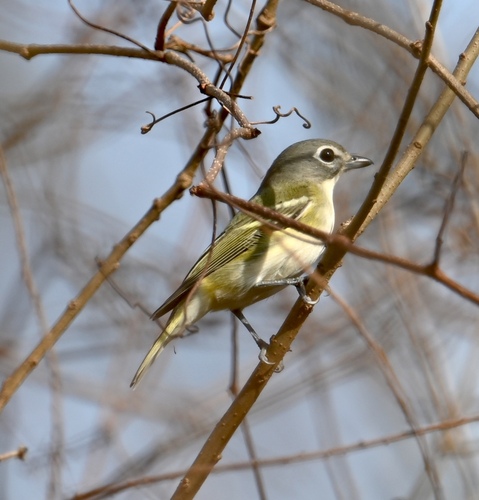
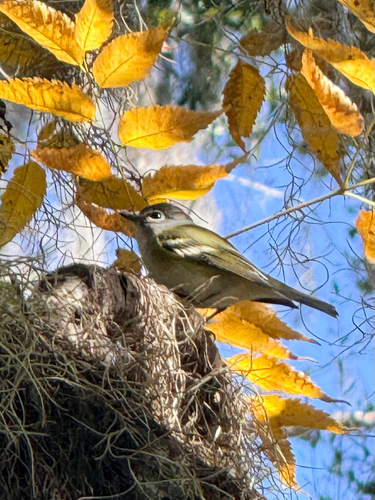
What the Blue-headed Vireo sounds like


ID tip
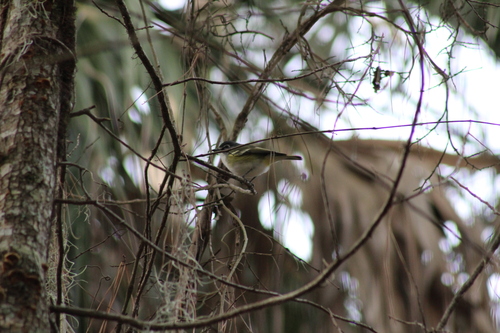
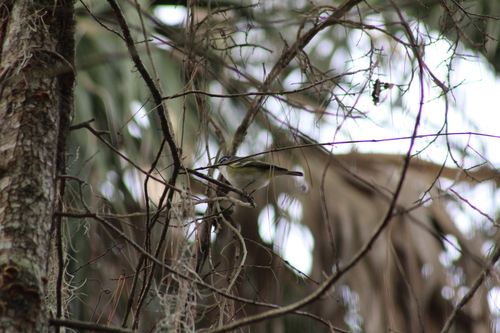
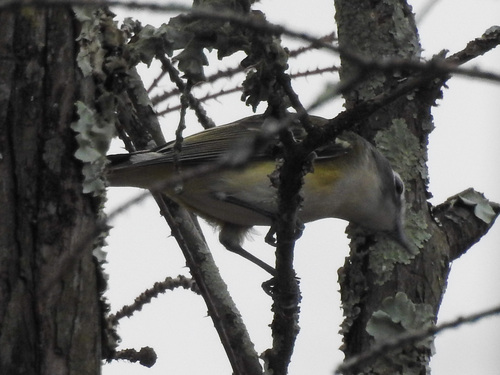
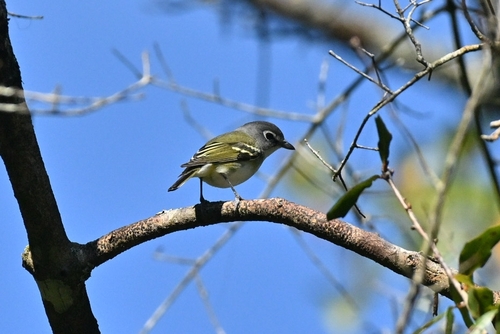
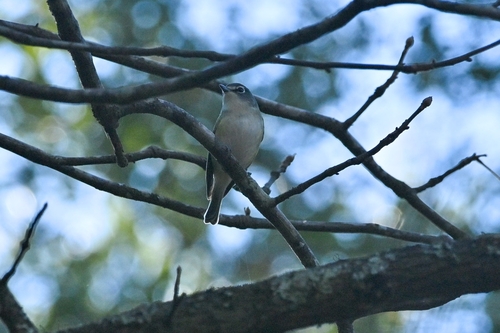
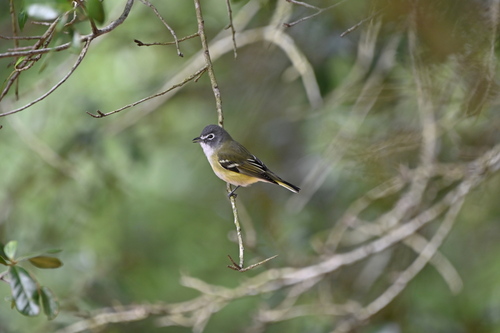
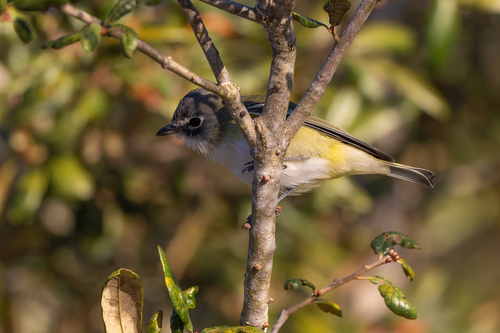
The blue-headed vireo has similar plumage year round and does not drastically change its appearance during the breeding season. It can be characterized by its olive green upper body, two bold yellow wing bars down the edge of its wing, and a deep blue-grey crown from which it gets its name. The juvenile plumage of immature blue-headed vireos is not distinct but very similar to the adult plumage. Voice: The primary song of the blue-headed vireo is a simple, slow, monotonous tune that is often confused with the faster red-eyed vireo (Vireo olivaceus) song. The primary song is sung only by the males and usually only during the breeding season. The males become quite vocal during the breeding season, with the song frequency reaching its height prior to mating and then decreasing after copulation.
Text from Wikipedia, licensed CC BY-SA 4.0.
When to see the Blue-headed Vireo
One bar for each month. Filled bars are the 8 months with records; pale bars are months with none. The wide bar is May, the month with the most records.
Where to see the Blue-headed Vireo
The map shades 14 countries with regular records, and 1 more in a lighter tone where the bird turns up only as a stray. Everything unshaded has no records. Countries are listed below the map.
Recorded as a rare visitor in Panama.
About the Blue-headed Vireo
The blue-headed vireo is a migrating song bird found in North and Central America. There are currently two recognized subspecies that belong to the blue-headed vireo. It has a range that extends across Canada and the eastern coast of the United States, Mexico, and some of Central America. It prefers large temperate forests with a mix of evergreen trees and deciduous under growth.
Text adapted from Wikipedia, licensed CC BY-SA 4.0.
Easily confused with
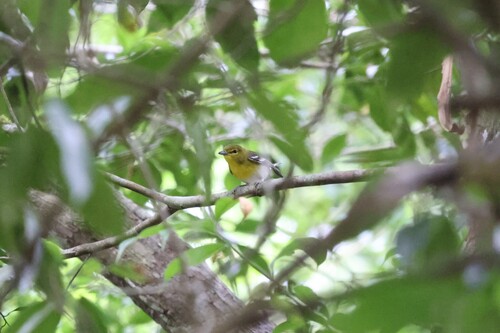 Yellow-throated VireoVireo flavifronsAdults are mainly olive on the head and upperparts with a yellow throat and white belly; they have dark eyes with yellow "spectacles".
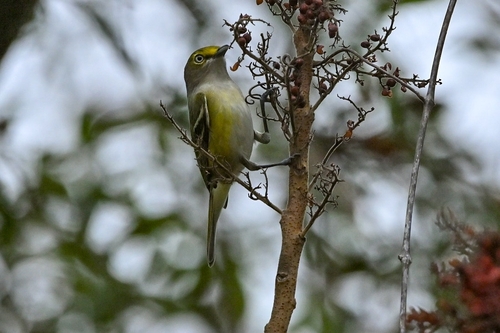 White-eyed VireoVireo griseusMeasurements:
Length: 4.3–5.1 in (11–13 cm)
Weight: 0.3–0.5 oz (10–14 g)
Wingspan: 6.7 in (17 cm)
Its head and back are a greyish olive, and the underparts are white with yellow flanks.
White-eyed VireoVireo griseusMeasurements:
Length: 4.3–5.1 in (11–13 cm)
Weight: 0.3–0.5 oz (10–14 g)
Wingspan: 6.7 in (17 cm)
Its head and back are a greyish olive, and the underparts are white with yellow flanks.
 Hutton's VireoVireo huttoniHutton's vireo is 10 to 12 cm (3.9 to 4.7 in) long and weighs about 9 to 15 g (0.32 to 0.53 oz).
Side by side: Blue-headed Vireo vs Red-eyed Vireo · Blue-headed Vireo vs White-eyed Vireo · Blue-headed Vireo vs Yellow-throated Vireo · Blue-headed Vireo vs Hutton's Vireo
Learn the Blue-headed Vireo in the BeakBrain App
Photo and call practice. Coming soon to iPhone and Android.
Play today's Daily BirdEvery photo and recording on this page is credited to its author under the licence shown. Spotted a problem with this page, or have a better photo? Contribute.