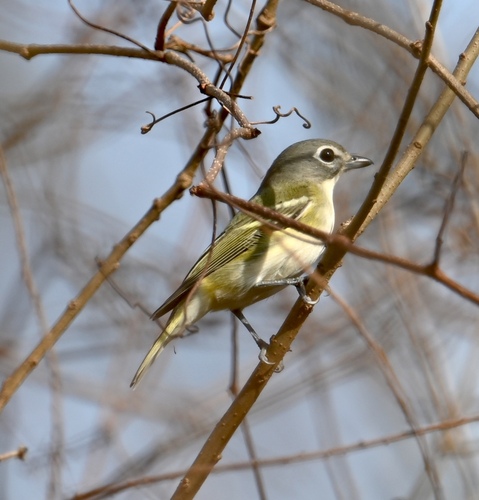
Blue-headed Vireo
Vireo solitarius
The blue-headed vireo has similar plumage year round and does not drastically change its appearance during the breeding season. It can be characterized by its olive green upper body, two bold yellow wing bars down the edge of its wing, and a deep blue-grey crown from which it gets its name. The juvenile plumage of immature blue-headed vireos is not distinct but very similar to the adult plumage. Voice: The primary song of the blue-headed vireo is a simple, slow, monotonous tune that is often confused with the faster red-eyed vireo (Vireo olivaceus) song. The primary song is sung only by the males and usually only during the breeding season. The males become quite vocal during the breeding season, with the song frequency reaching its height prior to mating and then decreasing after copulation.
ID text from Wikipedia, CC BY-SA 4.0

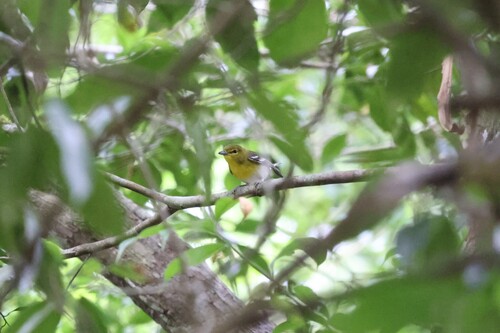
Yellow-throated Vireo
Vireo flavifrons
Adults are mainly olive on the head and upperparts with a yellow throat and white belly; they have dark eyes with yellow "spectacles". The tail and wings are dark with white wing bars. They have thick blue-grey legs and a stout bill. Measurements: Length: 5.1–5.9 in (13–15 cm) Weight: 0.5–0.7 oz (15–21 g) Wingspan: 9.1 in (23 cm)
ID text from Wikipedia, CC BY-SA 4.0
Where you might meet both
Learn this pair in the BeakBrain App
Photo and call practice. Coming soon to iPhone and Android.
Play today's Daily BirdPhotos and recordings are credited to their authors under the licence shown. Full profiles: Blue-headed Vireo and Yellow-throated Vireo.