Learn what every symbol on the card means.Full credits and sources at beakbrain.com/symbols
 DesertCavity nestSmall · 49 g


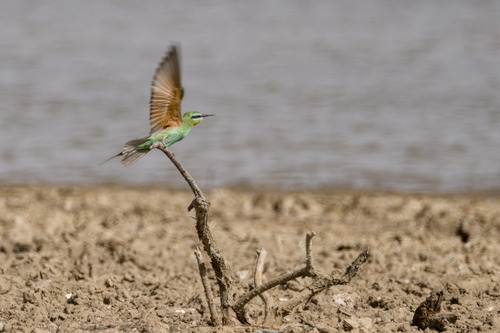

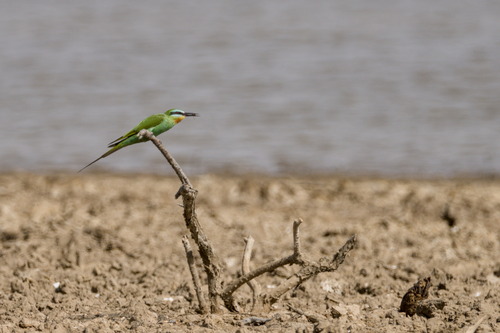
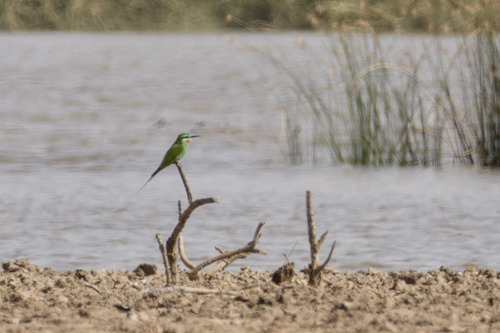
ID tip
This species, like other bee-eaters, is a richly coloured, slender bird. It is predominantly green; its face has blue sides with a black eye stripe, and a yellow and brown throat; the beak is black. It can reach a length of 31 cm (12 in), with the two elongated central tail feathers adding another 7 cm (2.8 in). Sexes are mostly alike but the tail-streamers of the female are shorter. This is a bird which breeds in sub-tropical semi-desert with a few trees, such as acacia. It winters in open woodland or grassland.
Text from Wikipedia, licensed CC BY-SA 4.0.
When to see the Blue-cheeked Bee-eater
One bar for each month. Filled bars are the 10 months with records; pale bars are months with none. The wide bar is September, the month with the most records.
Where to see the Blue-cheeked Bee-eater
The map shades 72 countries with regular records, and 15 more in a lighter tone where the bird turns up only as a stray. Everything unshaded has no records. Countries are listed below the map.
Recorded as a rare visitor in Sweden, United Kingdom, Spain, Finland, Norway, Portugal, France, Netherlands, China, Austria, Italy, Burkina Faso, Eritrea, Mayotte, Germany.
About the Blue-cheeked Bee-eater
The blue-cheeked bee-eater is a species of bee-eater that breeds in Northern Africa and the Middle East from eastern Turkey to Kazakhstan and India. It is generally strongly migratory, wintering in tropical Africa, although some populations are resident year-round in the Sahel. This species occurs as a rare vagrant north of its breeding range, with most vagrants occurring in Italy and Greece.
Text adapted from Wikipedia, licensed CC BY-SA 4.0.
Easily confused with
 Arabian Green Bee-eaterMerops cyanophrysIt is 16–18 centimetres (6.3–7.1 in) long excluding the elongated central tail feathers, which are an additional 2 cm (0.8 in) long.
 White-fronted Bee-eaterMerops bullockoidesThis species, like other bee-eaters, is a richly coloured, slender bird, but with a distinctive black mask, white forehead, square tail and a bright red throat.
 Blue-throated Bee-eaterMerops viridisAdult blue-throated bee-eaters are around 21 cm long, excluding the elongated central tail feathers, which are an additional 9 cm, and a weight of around 34–41 grams.
Side by side: Blue-cheeked Bee-eater vs Little Bee-eater · Blue-cheeked Bee-eater vs Chestnut-headed Bee-eater · Blue-cheeked Bee-eater vs White-fronted Bee-eater · Arabian Green Bee-eater vs Blue-cheeked Bee-eater · Blue-cheeked Bee-eater vs Blue-throated Bee-eater
Learn the Blue-cheeked Bee-eater in the BeakBrain App
Photo and call practice. Coming soon to iPhone and Android.
Play today's Daily BirdEvery photo and recording on this page is credited to its author under the licence shown. Spotted a problem with this page, or have a better photo? Contribute.