Learn what every symbol on the card means.Full credits and sources at beakbrain.com/symbols
 ForestCup nestSmall · 17 g
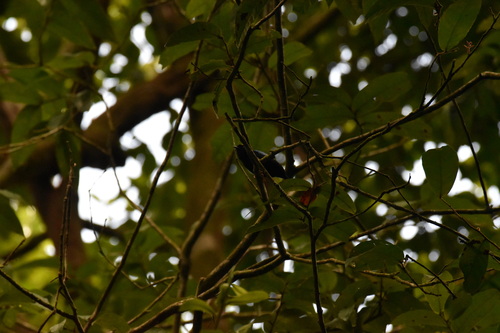
What the Blue-backed Manakin sounds like


ID tip
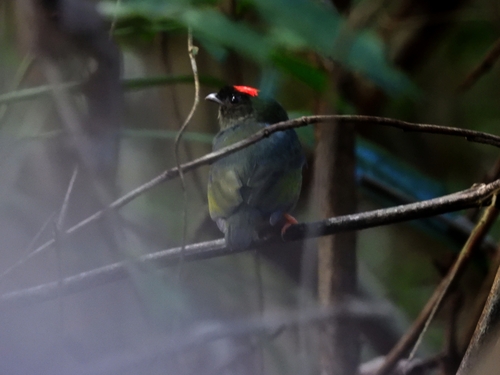
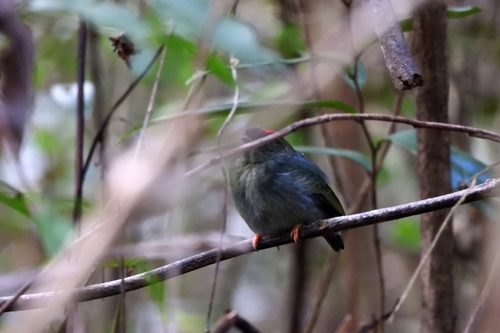
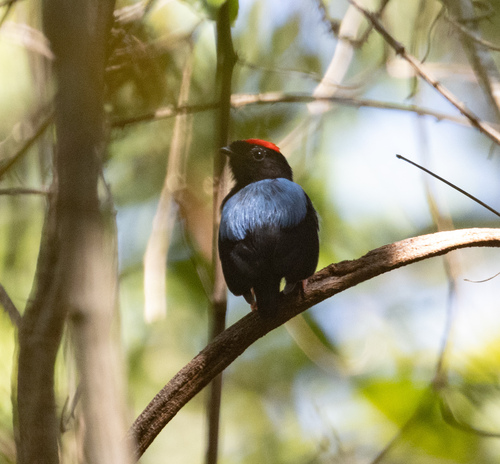
Like other manakins, the blue-backed manakin is a compact, brightly coloured forest bird, typically 13 cm long and weighing 19 g. The male is mainly black with a bright blue back, and pale orange legs. The crown is typically red, but yellow in C. pareola regina from the south-west Amazon. The female has olive-green upperparts, and somewhat paler olive underparts. Young males are olive, but show a red cap and the start of a blue back as they mature. The race endemic to Tobago, C. p. atlantica is larger and has more extensive red on the crown and blue on the back.
Text from Wikipedia, licensed CC BY-SA 4.0.
When to see the Blue-backed Manakin
One bar for each month, and every month is filled: this bird is recorded here in all twelve. The wide bar is November, the month with the most records.
Where to see the Blue-backed Manakin
The map shades 10 countries with regular records. Everything unshaded has no records. Countries are listed below the map.
About the Blue-backed Manakin
The blue-backed manakin is a small passerine bird which breeds in tropical South America, its range extending from Colombia and Tobago to southeastern Brazil. It is found in deciduous forests but not evergreen rainforests. It is a small, plump bird about 13 centimetres (5 in) long. Males have black plumage with a bright blue back and a red or yellow crown. Females and juveniles are olive-green with paler underparts. At breeding time, males are involved in a cooperative lekking behaviour during which they jump and twirl. This is a fairly common species with a wide range, and the International Union for Conservation of Nature has rated its conservation status as being of "least concern".
Text adapted from Wikipedia, licensed CC BY-SA 4.0.
Easily confused with
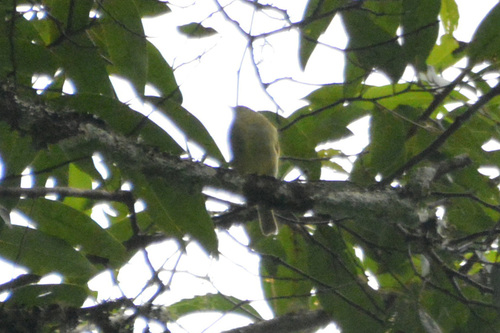 Yungas ManakinChiroxiphia bolivianaThe Yungas manakin is 12 to 13 cm (4.7 to 5.1 in) long and weighs about 14 to 22 g (0.49 to 0.78 oz).
 Araripe ManakinChiroxiphia bokermanniAs typical of most manakins, males and females have a strong sexual dimorphism in the colours of the plumage.
 Helmeted ManakinChiroxiphia galeataThe helmeted manakin has sexually dimorphic plumage.
Side by side: Blue-backed Manakin vs Blue Manakin · Blue-backed Manakin vs Long-tailed Manakin · Blue-backed Manakin vs Lance-tailed Manakin · Blue-backed Manakin vs Yungas Manakin
Learn the Blue-backed Manakin in the BeakBrain App
Photo and call practice. Coming soon to iPhone and Android.
Play today's Daily BirdEvery photo and recording on this page is credited to its author under the licence shown. Spotted a problem with this page, or have a better photo? Contribute.