Learn what every symbol on the card means.Full credits and sources at beakbrain.com/symbols
 ForestPlatform nestLarge · 352 g


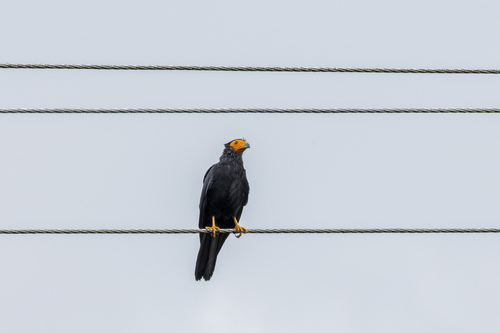
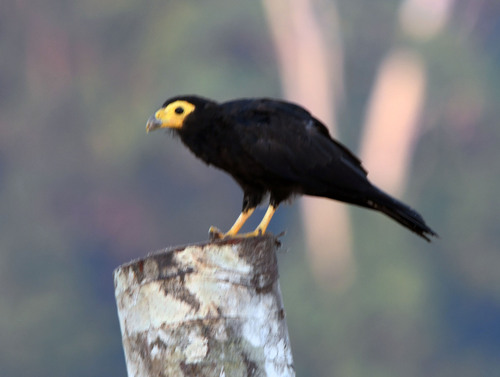
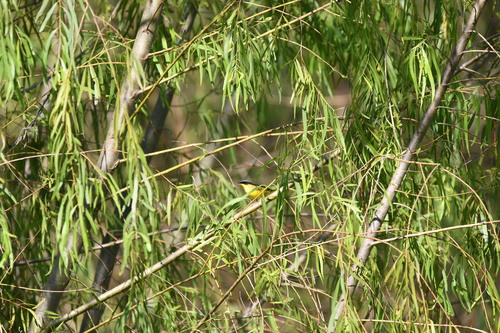
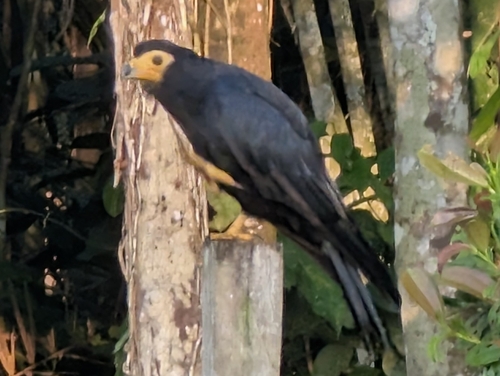
What the Black Caracara sounds like

ID tip
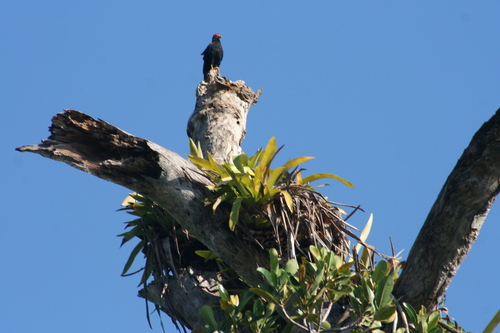
Adult black caracara are a glossy black except for the distinctive white band on the base of the tail, and yellow to orange-red feet and face. The adults appear similar to those of their closest relative, the red-throated caracara, however they have distinctly long and narrow wings and tail, as well as a black beak. Additionally, the red-throated caracara can be distinguished from the black caracara by their red throats. The average adult length is 41–47 cm (16–19 in)-. Voice: This species can also be identified from other species by their harsh, piercing, single note kraaaa calls that usually occur during flight. This call is usually repeated several times, often ending in a decrescendo. They do not exhibit diverse vocalizations, restricted to variations in length and volume of their distinctive shriek.
Text from Wikipedia, licensed CC BY-SA 4.0.
When to see the Black Caracara
One bar for each month, and every month is filled: this bird is recorded here in all twelve. The wide bar is July, the month with the most records.
Where to see the Black Caracara
The map shades 9 countries with regular records. Everything unshaded has no records. Countries are listed below the map.
About the Black Caracara
The black caracara is a bird of prey in the family Falconidae that is found in Amazonian and French Guianan lowlands, mainly occurring along rivers. It was formerly the only species placed in the genus Daptrius but based on genetic studies the genus now includes species that were formerly placed in the genera Milvago and Phalcoboenus.
Text adapted from Wikipedia, licensed CC BY-SA 4.0.
Easily confused with
 Yellow-headed CaracaraDaptrius chimachimaThe yellow-headed caracara is 40 to 45 cm (16 to 18 in) long.
 Chimango CaracaraDaptrius chimangoThe chimango caracara is 32 to 43 cm (13 to 17 in) long and weighs 170 to 260 g (6.0 to 9.2 oz).
 Carunculated CaracaraDaptrius carunculatusThe carunculated caracara is 50 to 56 cm (20 to 22 in) long with a wingspan of 112 to 119 cm (44 to 47 in).
Learn the Black Caracara in the BeakBrain App
Photo and call practice. Coming soon to iPhone and Android.
Play today's Daily BirdEvery photo and recording on this page is credited to its author under the licence shown. Spotted a problem with this page, or have a better photo? Contribute.