Learn what every symbol on the card means.Full credits and sources at beakbrain.com/symbols
 ForestGround nestMedium · 215 g


ID tip
The chimango caracara is 32 to 43 cm (13 to 17 in) long and weighs 170 to 260 g (6.0 to 9.2 oz). Its wingspan is 80 to 99 cm (31 to 39 in). The sexes' plumages are alike. Adults of the nominate subspecies are mostly brownish throughout. They have dark streaks on the side of the head and on their hindneck. Their undersides are mottled or barred with rufous-brown. Their uppertail coverts are white and their tail is mottled grayish and white with a wide black band near the end. Also, their iris is brown. Males have bare yellow skin around the eye and yellow legs and feet. Voice: The chimango caracara is usually most vocal during the breeding season "particularly if human or other intruders near nest", but also calls during disputes over food. Its most common call is a "loud petulant squealing keeeeee-eh" that is usually made singly and often in flight. It also makes a "more chattering ... keag-keah-keah ...
Text from Wikipedia, licensed CC BY-SA 4.0.
About the Chimango Caracara
The chimango caracara, also known as chimango or tiuque, is a species of bird of prey in the family Falconidae, the falcons and caracaras. It is found in Argentina, Bolivia, Brazil, Chile, Paraguay, and Uruguay, as a vagrant on the Falkland Islands and has been introduced on Rapa Nui.
Text adapted from Wikipedia, licensed CC BY-SA 4.0.
Easily confused with
 Yellow-headed CaracaraDaptrius chimachimaThe yellow-headed caracara is 40 to 45 cm (16 to 18 in) long.
 Carunculated CaracaraDaptrius carunculatusThe carunculated caracara is 50 to 56 cm (20 to 22 in) long with a wingspan of 112 to 119 cm (44 to 47 in).
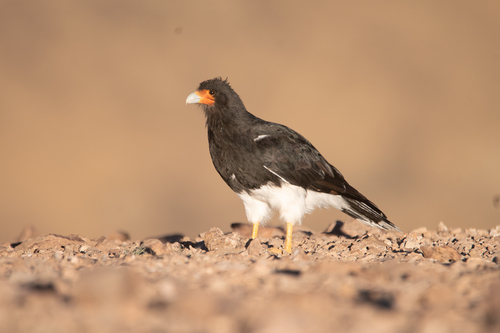 Mountain CaracaraDaptrius megalopterusA medium-sized caracara with a faintly blue beak tip turning to bright orange, strongly contrasted by the jet-black feathers of its head, back and chest.
Learn the Chimango Caracara in the BeakBrain App
Photo and call practice. Coming soon to iPhone and Android.
Play today's Daily BirdEvery photo and recording on this page is credited to its author under the licence shown. Spotted a problem with this page, or have a better photo? Contribute.