Learn what every symbol on the card means.Full credits and sources at beakbrain.com/symbols
 ForestCavity nestTiny · 11 g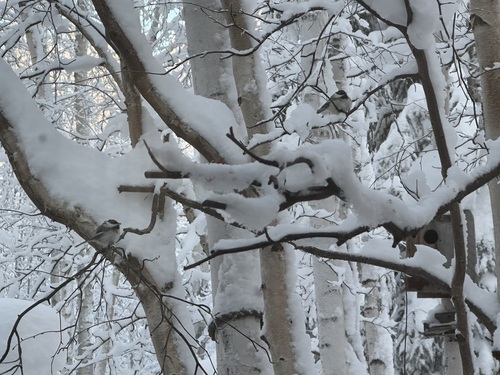
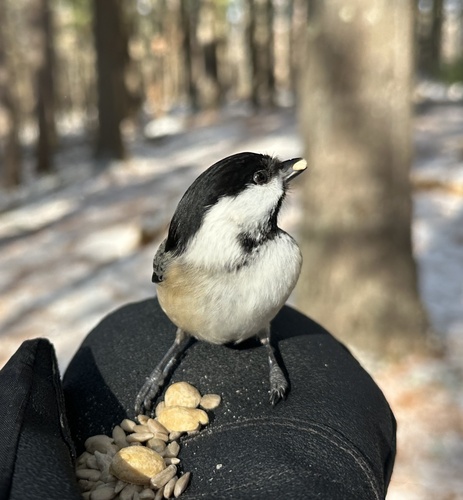
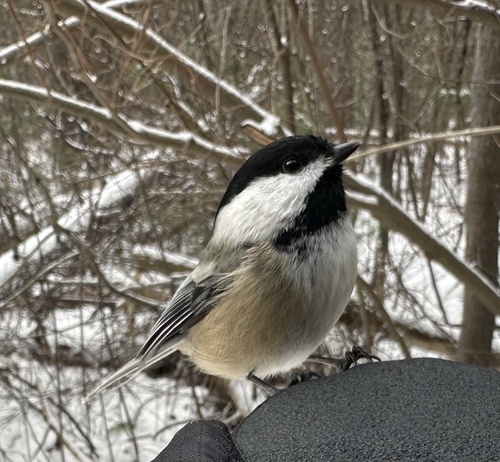
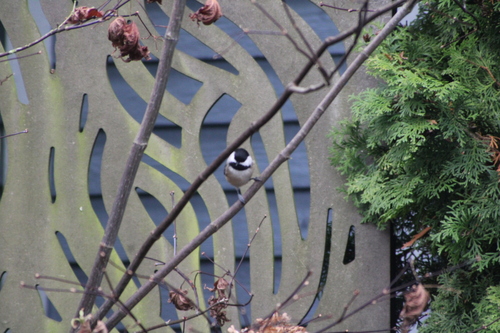


What the Black-capped Chickadee sounds like


ID tip
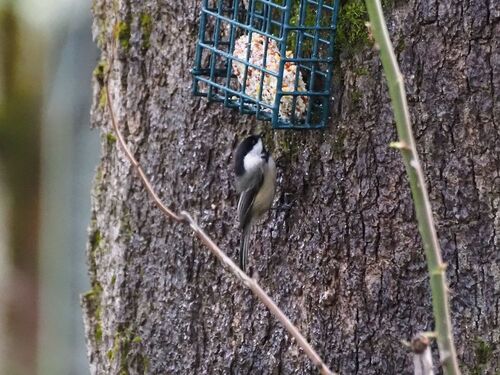
The black-capped chickadee has a black cap and "bib" with white cheeks. Its underparts are white with buff-coloured flanks. Its back is unstreaked and greenish grey, and the tail and wings are slate grey. It has a black beak and legs, and dark brown irises. Males and females are generally similar, although males have a larger bib. They can also be distinguished based on a combination of weight and tail length. Tarsus length does not significantly differentiate sexes. Males have a wing length of 63.5–67.5 mm (2.50–2.66 in), a tail length of 58–63 mm (2.3–2.5 in), a bill length of 8–9.5 mm (0. Voice: The vocalizations of the black-capped chickadee are highly complex, with 16 distinct types of vocalizations being used to convey an array of information. These vocalizations are likely an evolutionary adaptation to their habitat; they live and feed in dense vegetation, and even when the flock is close together, individual birds tend to be out of each other's visual range.
Text from Wikipedia, licensed CC BY-SA 4.0.
When to see the Black-capped Chickadee
One bar for each month, and every month is filled: this bird is recorded here in all twelve. The wide bar is May, the month with the most records.
Where to see the Black-capped Chickadee
The map shades 3 countries with regular records, and 1 more in a lighter tone where the bird turns up only as a stray. Everything unshaded has no records. Countries are listed below the map.
Recorded as a rare visitor in France.
About the Black-capped Chickadee
The black-capped chickadee is a small, nonmigratory, North American passerine bird that lives in deciduous and mixed forests. It is a member of the Paridae family, also known as tits. It has a distinct black cap on its head, a black bib underneath, and white cheeks. It has a white belly, buff sides, and grey wings, back, and tail. The bird is well known for its vocalizations, including its fee-bee song and its chick-a-dee-dee-dee call, from which it derives its name.
Text adapted from Wikipedia, licensed CC BY-SA 4.0.
Easily confused with
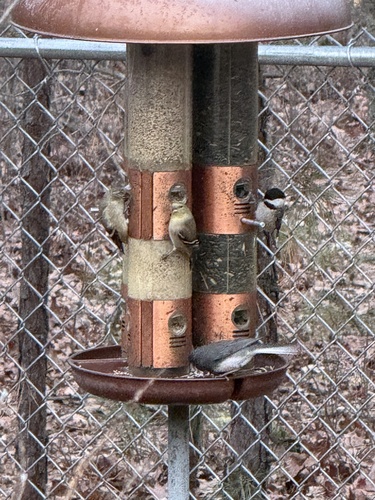 Carolina ChickadeePoecile carolinensisAdults are 11.5–13 cm (4.5–5.1 in) long with a weight of 9–12 g (0.32–0.42 oz), and have a black cap and bib with white sides to the face.
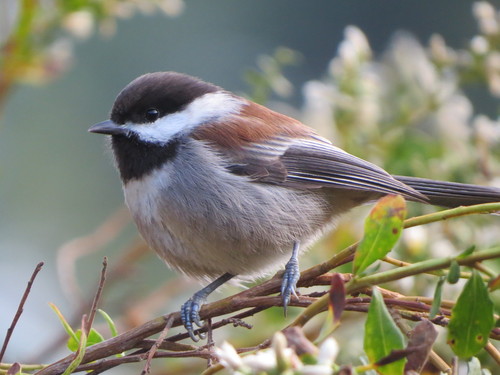 Chestnut-backed ChickadeePoecile rufescensIt is a small chickadee, 11.5–12.5 cm (4.5–4.9 in) long with a weight of 8.5–12.6 g (0.30–0.44 oz).
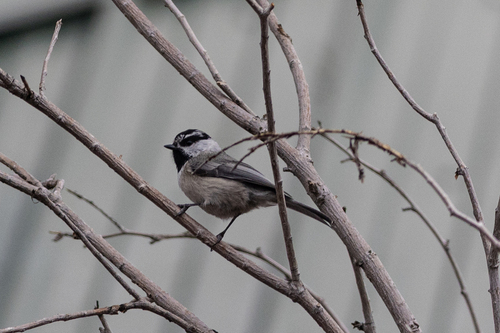 Mountain ChickadeePoecile gambeliAdults of both sexes have a black cap joining a black postocular stripe behind distinctive white eyebrows.
Side by side: Black-capped Chickadee vs Carolina Chickadee · Black-capped Chickadee vs Chestnut-backed Chickadee · Black-capped Chickadee vs Mountain Chickadee
Watch the Black-capped Chickadee on live cams
Browse all 118 bird cams worldwide, live and seasonal, by region and species.
Learn the Black-capped Chickadee in the BeakBrain App
Photo and call practice. Coming soon to iPhone and Android.
Play today's Daily BirdEvery photo and recording on this page is credited to its author under the licence shown. Spotted a problem with this page, or have a better photo? Contribute.