Learn what every symbol on the card means.Full credits and sources at beakbrain.com/symbols
 ForestCup nestSmall · 28 g


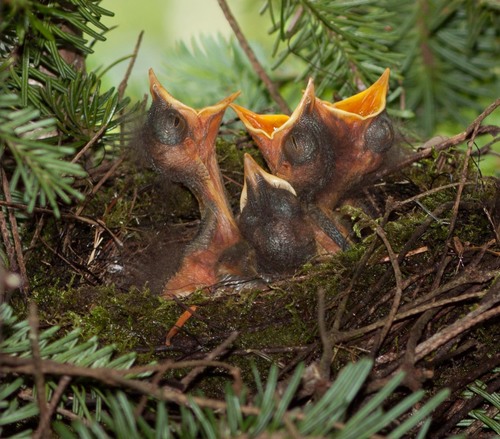
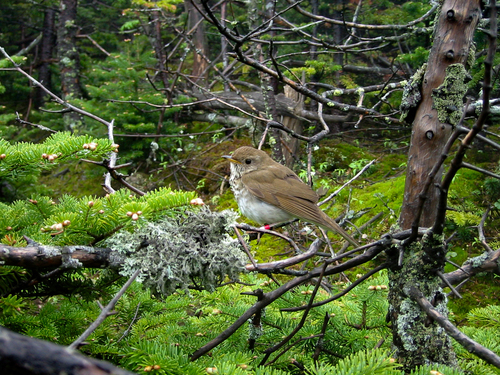
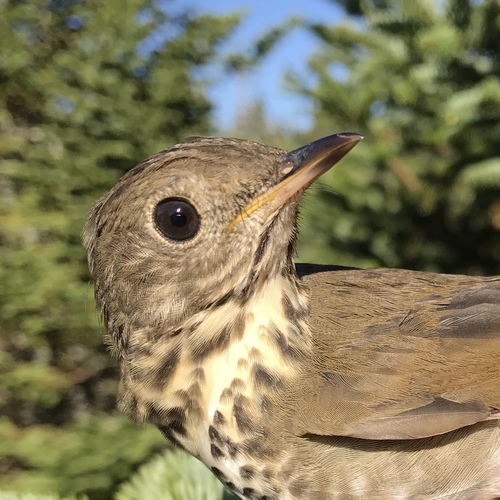
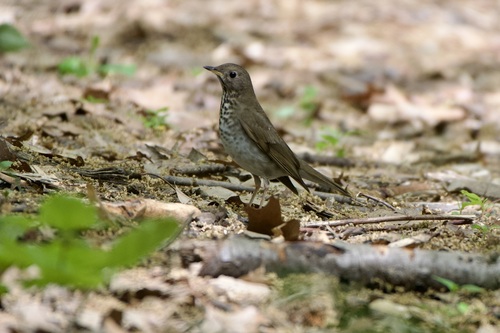
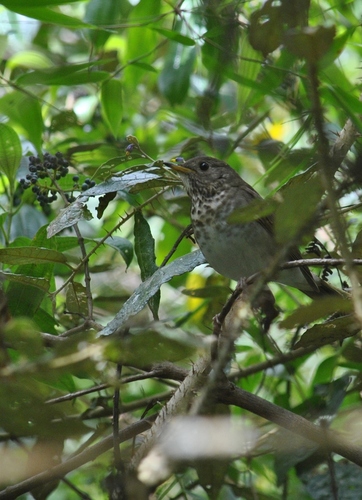
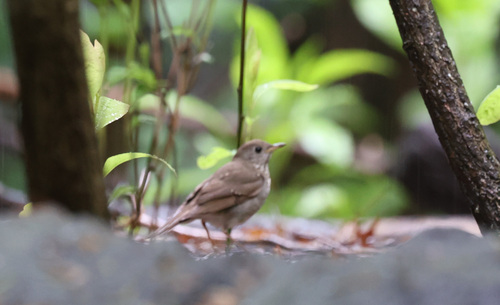
What the Bicknell's Thrush sounds like


ID tip
Bicknell's thrush is just slightly smaller than the other northern migratory Catharus thrushes, with an average length of approximately 17 cm (6.7 in) and a weight ranging generally from 26 to 30g. Both sexes are identical in the field and are roughly the same size, although males average slightly larger in wing length. Adults are olive-brown to brownish on the upperparts (head, nape, back) contrasting with chestnut-tinged tail. The contrast is, however, less evident in worn plumage. Voice: Vocalizing mostly at dawn and dusk, the song is mostly performed by the male, but sometimes also by females. Like all North American thrushes, Bicknell's thrush song is flute-like. High pitched and vibrant, the song is composed of four phrases: "chook-chook, wee-o, wee-o, wee-o-ti-t-ter-ee". Unlike in the gray-cheeked thrush, the pitch of the last phrase is constant or rising.
Text from Wikipedia, licensed CC BY-SA 4.0.
When to see the Bicknell's Thrush
One bar for each month. Filled bars are the 3 months with records; pale bars are months with none. The wide bar is June, the month with the most records.
Where to see the Bicknell's Thrush
The map shades 7 countries with regular records, and 2 more in a lighter tone where the bird turns up only as a stray. Everything unshaded has no records. Countries are listed below the map.
Recorded as a rare visitor in Bermuda, Guadeloupe.
About the Bicknell's Thrush
Bicknell's thrush is a medium-sized thrush, at 17.5 cm (6.9 in) and 28 g (0.99 oz). One of North America's rarest and most localized songbirds, it breeds on coniferous mountain tops and disturbed habitats of northeastern North America. While very similar in appearance and vocalization to the gray-cheeked thrush, the two species differ slightly in their morphology and vocalizations, although they have with completely different breeding ranges. It was named after Eugene Bicknell, an American amateur ornithologist, who made the first scientific discovery of the species on Slide Mountain in the Catskills in the late 19th century.
Text adapted from Wikipedia, licensed CC BY-SA 4.0.
Easily confused with
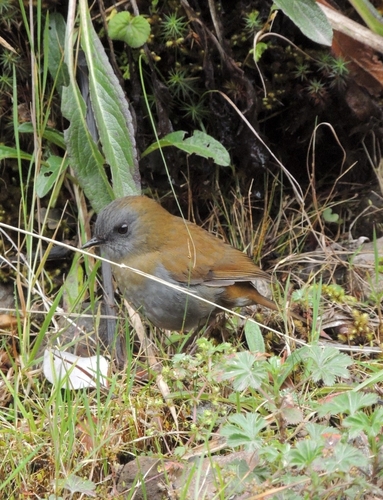 Black-billed Nightingale-ThrushCatharus gracilirostrisThe black-billed nightingale-thrush is about 15 cm (5.9 in) long and weighs about 20 g (0.71 oz) The sexes have the same plumage.
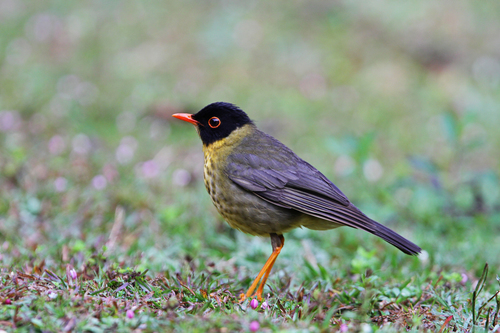 Yellow-throated Nightingale-ThrushCatharus dryasThe yellow-throated nightingale-thrush is 17 to 19 cm (6.7 to 7.5 in) long and weighs 36 to 44 g (1.3 to 1.6 oz).
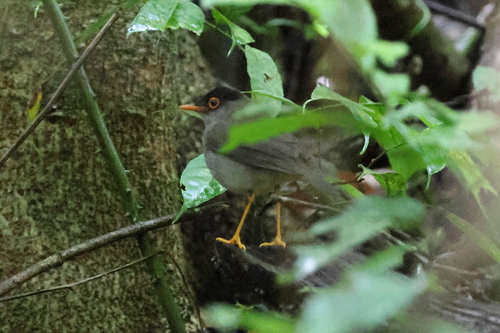 Black-headed Nightingale-ThrushCatharus mexicanusThe black-headed nightingale-thrush is 15 to 16.5 cm (5.9 to 6.5 in) long and weighs about 30 g (1.1 oz).
Side by side: Bicknell's Thrush vs Black-headed Nightingale-Thrush · Bicknell's Thrush vs Black-billed Nightingale-Thrush · Bicknell's Thrush vs Yellow-throated Nightingale-Thrush · Bicknell's Thrush vs Russet Nightingale-Thrush
Learn the Bicknell's Thrush in the BeakBrain App
Photo and call practice. Coming soon to iPhone and Android.
Play today's Daily BirdEvery photo and recording on this page is credited to its author under the licence shown. Spotted a problem with this page, or have a better photo? Contribute.