
Bicknell's Thrush
Catharus bicknelli
Bicknell's thrush is just slightly smaller than the other northern migratory Catharus thrushes, with an average length of approximately 17 cm (6.7 in) and a weight ranging generally from 26 to 30g. Both sexes are identical in the field and are roughly the same size, although males average slightly larger in wing length. Adults are olive-brown to brownish on the upperparts (head, nape, back) contrasting with chestnut-tinged tail. The contrast is, however, less evident in worn plumage. Voice: Vocalizing mostly at dawn and dusk, the song is mostly performed by the male, but sometimes also by females. Like all North American thrushes, Bicknell's thrush song is flute-like. High pitched and vibrant, the song is composed of four phrases: "chook-chook, wee-o, wee-o, wee-o-ti-t-ter-ee". Unlike in the gray-cheeked thrush, the pitch of the last phrase is constant or rising.
ID text from Wikipedia, CC BY-SA 4.0

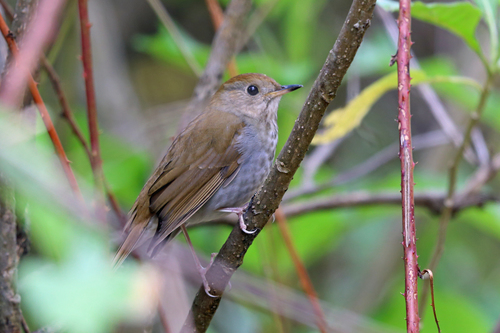
Russet Nightingale-Thrush
Catharus occidentalis
The russet nightingale-thrush is 15.5 to 18 cm (6.1 to 7.1 in) long and weighs 22 to 37 g (0.78 to 1.3 oz). The sexes have the same plumage. Adults of the nominate subspecies C. o. occidentalis have a deep russet brown crown and nape and a light olive brown or buffy olive face. Their upperparts are mostly a more olivaceous russet brown than the crown but the uppertail coverts and tail are more rufescent than the back. Their wings are mostly colored like the back but have buffy at the base of the flight feathers' inner webs. Voice: The russet nightingale-thrush's song is "varied, thin phrases with tinny quality, not particularly musical she-vee-ee-i-lu or chee ti-vee, etc." that is sometimes repeated in fairly rapid succession. Its calls include "a quiet, low, slightly gruff chuk or chruh, and a nasal, mewing reear".
ID text from Wikipedia, CC BY-SA 4.0
Learn this pair in the BeakBrain App
Photo and call practice. Coming soon to iPhone and Android.
Play today's Daily BirdPhotos and recordings are credited to their authors under the licence shown. Full profiles: Bicknell's Thrush and Russet Nightingale-Thrush.