Learn what every symbol on the card means.Full credits and sources at beakbrain.com/symbols
 RockyScrapeLarge · 416 g


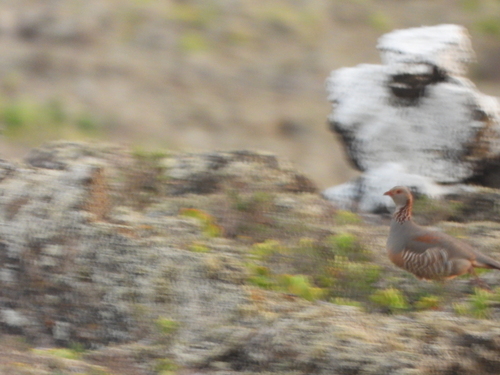

ID tip
The Barbary partridge is a rotund bird, with a grey-brown back, grey breast and buff belly. The face is light grey with a broad reddish-brown gorget. It has rufous-streaked white flanks and red legs. When disturbed, it prefers to run rather than fly, but if necessary it flies a short distance on rounded wings. It is closely related to its western European equivalent, the red-legged partridge. It is similar to the red-legged partridge, but it has a different head and neck pattern. The song is a noisy tre-tre-tre-tre-tre-cheeche-tre-tre-tre.
Text from Wikipedia, licensed CC BY-SA 4.0.
When to see the Barbary Partridge
One bar for each month. Filled bars are the 11 months with records; pale bars are months with none. The wide bar is March, the month with the most records.
Where to see the Barbary Partridge
The map shades 8 countries with regular records, and 1 more in a lighter tone where the bird turns up only as a stray. Everything unshaded has no records. Countries are listed below the map.
Recorded as a rare visitor in France.
About the Barbary Partridge
The Barbary partridge is a gamebird in the pheasant family (Phasianidae) of the order Galliformes. It is native to North Africa.
Text adapted from Wikipedia, licensed CC BY-SA 4.0.
Easily confused with
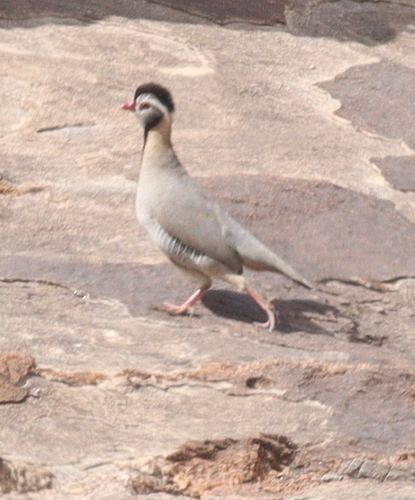 Arabian PartridgeAlectoris melanocephalaLarger than other members of its genus, Alectoris, the Arabian partridge reaches a length of about 41 cm (16 in).
 Przevalski's PartridgeAlectoris magnaPrzevalski's partridge or the rusty-necklaced partridge, is a bird species in the family Phasianidae.
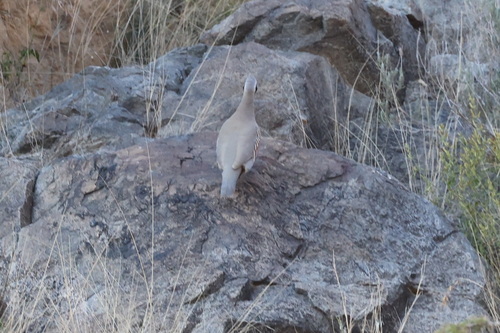 Philby's PartridgeAlectoris philbyiPhilby's partridge is similar in appearance to the chukar partridge and has greyish-brown plumage with the flanks boldly banded in black and pale buff.
Side by side: Barbary Partridge vs Red-legged Partridge · Barbary Partridge vs Chukar Partridge · Barbary Partridge vs Rock Partridge · Arabian Partridge vs Barbary Partridge
Learn the Barbary Partridge in the BeakBrain App
Photo and call practice. Coming soon to iPhone and Android.
Play today's Daily BirdEvery photo and recording on this page is credited to its author under the licence shown. Spotted a problem with this page, or have a better photo? Contribute.