Learn what every symbol on the card means.Full credits and sources at beakbrain.com/symbols
 ForestCavity nestMedium · 198 g


ID tip
The Asian barred owlet is a small owl that sits at 22–25 cm (8.7–9.8 in). The males weigh 150–176 g (0.331–0.388 lb) and the females up to 240 g (0.53 lb). Like most owls in the true owl family, the females are usually larger than the males. They are dark brown or olive-brown with a white throat patch and are densely barred. Their breast and belly is whitish in colour with dark brown bars. Its tail and wings are dark brown with whitish bars. Unlike other pygmy owl species, they do not have false eyes on the back of their head. Voice: The male song is a trill lasting anywhere from 5–20 seconds, progressively becoming louder and harsher notes before stopping abruptly, transcribed as "kwuhk kwuhk-ke-kwuhk kwuhk-kekekwurre kwurre kwurre-kwurrekwurrekwurre kwurrekwurr". They also have a common call which is a smooth "hoot".
Text from Wikipedia, licensed CC BY-SA 4.0.
When to see the Asian Barred Owlet
One bar for each month. Filled bars are the 8 months with records; pale bars are months with none. The wide bar is February, the month with the most records.
Where to see the Asian Barred Owlet
The map shades 12 countries with regular records. Everything unshaded has no records. Countries are listed below the map.
About the Asian Barred Owlet
The Asian barred owlet, also known as the cuckoo owlet, is a species of pygmy owl native to the forests and shrublands of mainland Southeast Asia to the foothills of the Himalayas of northern Pakistan. It is a smaller owl, measuring 22–25 cm (8.7–9.8 in), making it one of the larger pygmy owls. They are primarily insectivorous but will eat lizards, small rodents and birds as well.
Text adapted from Wikipedia, licensed CC BY-SA 4.0.
Easily confused with
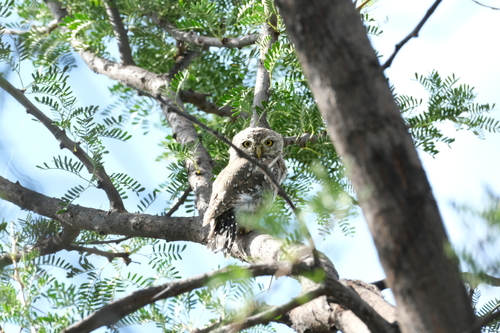 Pearl-spotted OwletGlaucidium perlatumThe pearl-spotted owlet is one of the smallest owls in Africa with a length of 17 to 21 cm.
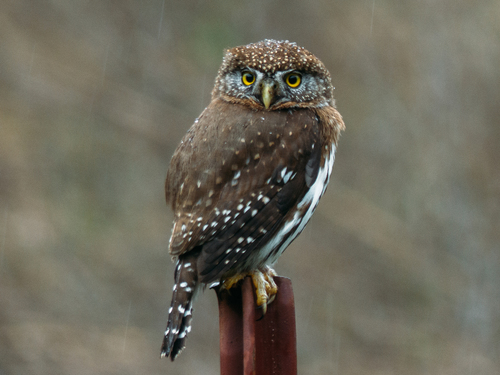 Northern Pygmy OwlGlaucidium gnomaThe adult mountain pygmy owl is approximately 15–17 cm (5.9–6.7 in) in length.
 Jungle OwletGlaucidium radiatumThis small owlet has a rounded head and is finely barred all over.
Side by side: Asian Barred Owlet vs Jungle Owlet · Asian Barred Owlet vs Northern Pygmy Owl · Asian Barred Owlet vs Pearl-spotted Owlet
Learn the Asian Barred Owlet in the BeakBrain App
Photo and call practice. Coming soon to iPhone and Android.
Play today's Daily BirdEvery photo and recording on this page is credited to its author under the licence shown. Spotted a problem with this page, or have a better photo? Contribute.