Learn what every symbol on the card means.Full credits and sources at beakbrain.com/symbols
 GrasslandCavity nestMedium · 115 g

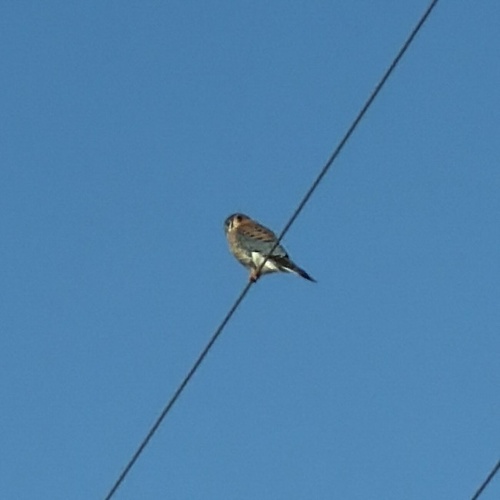
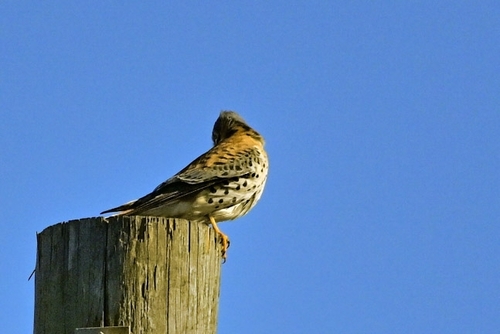
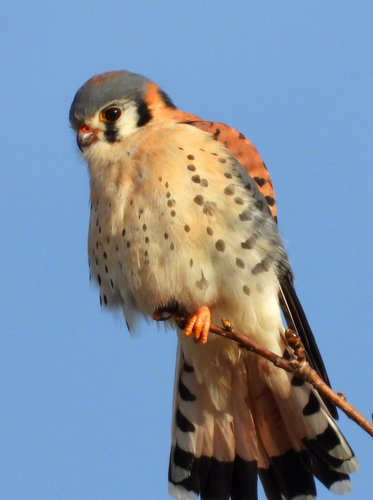
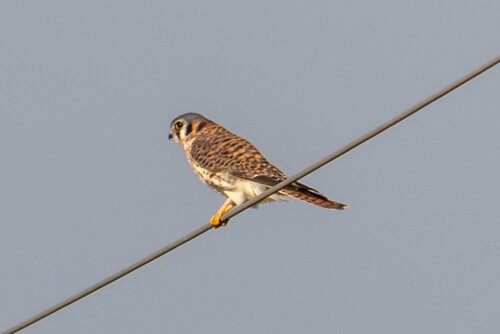
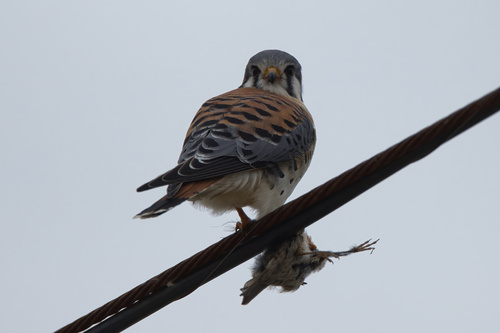
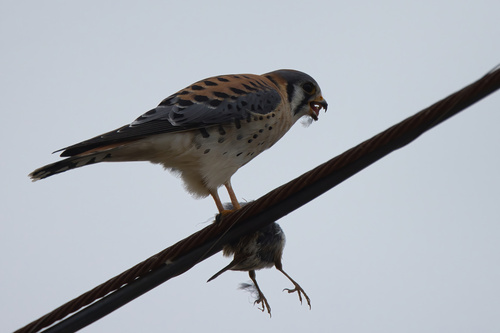
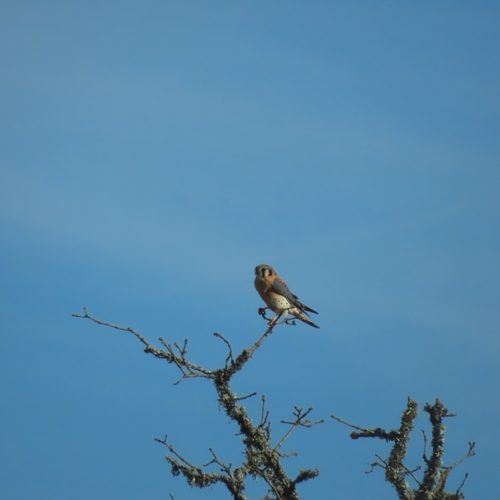
What the American Kestrel sounds like


ID tip
Under traditional terminology, the American kestrel is the smallest raptor in the Americas, though the South American spot-winged falconet is almost as small. The American kestrel is sexually dimorphic, although there is some overlap in plumage coloration between the sexes. The bird ranges from 22 to 31 cm (8.7 to 12.2 in) in length with a wingspan of 51–61 cm (20–24 in). The female kestrel is larger than the male, though less so than larger falcons, being typically about 10% to 15% larger within a subspecies. Voice: The American kestrel has three basic vocalizations – the "klee" or "killy", the "whine", and the "chitter". The "klee" is usually delivered as a rapid series – klee, klee, klee, klee when the kestrel is upset or excited. This call is used in a wide variety of situations and is heard from both sexes, but the larger females typically have lower-pitched voices than the males.
Text from Wikipedia, licensed CC BY-SA 4.0.
When to see the American Kestrel
One bar for each month, and every month is filled: this bird is recorded here in all twelve. The wide bar is January, the month with the most records.
Where to see the American Kestrel
The map shades 50 countries with regular records, and 4 more in a lighter tone where the bird turns up only as a stray. Everything unshaded has no records. Countries are listed below the map.
Recorded as a rare visitor in Spain, Belgium, United Kingdom, French Guiana.
About the American Kestrel
The American kestrel is the smallest and most common falcon in the Americas. Though it has been called the American "sparrow hawk", this now obsolete vernacular name is a misnomer; the American kestrel is a true falcon, while neither the Eurasian sparrowhawk nor the other species called sparrowhawks are in the family Falconidae, hence only very distantly related to the American kestrel. It has a roughly two-to-one range in size over subspecies and sex, varying in size from about the weight of a blue jay to a mourning dove.
Text adapted from Wikipedia, licensed CC BY-SA 4.0.
Easily confused with
 Common KestrelFalco tinnunculusThe common kestrel measures 32–39 cm (12+1⁄2–15+1⁄2 in) from head to tail, with a wingspan of 65–82 cm (25+1⁄2–32+1⁄2 in).
 Peregrine FalconFalco peregrinusThe peregrine falcon has a body length of 34 to 58 cm (13–23 in) and a wingspan from 74 to 120 cm (29–47 in).
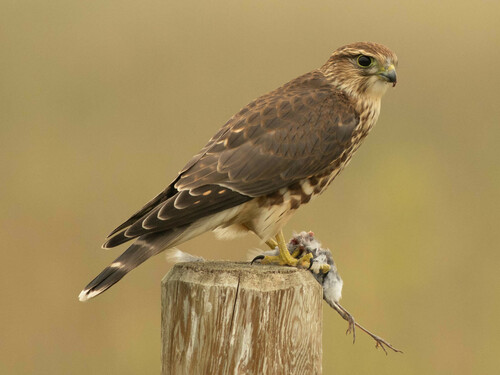 MerlinFalco columbariusThe merlin is 24–33 cm (9.4–13.0 in) long with a 50–73 cm (20–29 in) wingspan.
Side by side: American Kestrel vs Common Kestrel · American Kestrel vs Peregrine Falcon · American Kestrel vs Merlin
Watch the American Kestrel on live cams
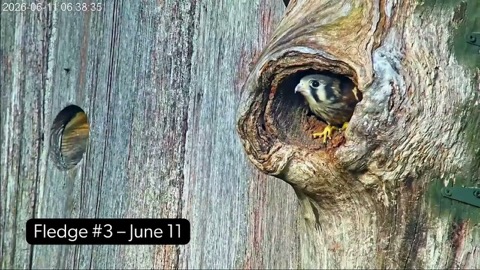 RETURNS APRIL
Browse all 118 bird cams worldwide, live and seasonal, by region and species.
Learn the American Kestrel in the BeakBrain App
Photo and call practice. Coming soon to iPhone and Android.
Play today's Daily BirdEvery photo and recording on this page is credited to its author under the licence shown. Spotted a problem with this page, or have a better photo? Contribute.