Learn what every symbol on the card means.Full credits and sources at beakbrain.com/symbols
 ForestCavity nestMedium · 115 g


ID tip
The Amazonian motmot's plumage varies among the subspecies. The bodies of all are shades of green. All have a long tail that has extended feathers with racquet tips that are green or black. Most have a black eyemask, though their size and shape differ. The central crown is black and surrounded or partially bordered by a blue band. The nominate subspecies has a chestnut nape. Momotus momota ignobilis and M. m. cametensis have more extensive chestnut on the neck and face. Voice: The Amazonian motmot's song has been described as "a fast, hollow hoo-do" and "a bubbling whOOP-oo". It also makes "a gruff kak", sometimes in a series.
Text from Wikipedia, licensed CC BY-SA 4.0.
When to see the Amazonian Motmot
One bar for each month, and every month is filled: this bird is recorded here in all twelve. The wide bar is October, the month with the most records.
Where to see the Amazonian Motmot
The map shades 11 countries with regular records, and 3 more in a lighter tone where the bird turns up only as a stray. Everything unshaded has no records. Countries are listed below the map.
Recorded as a rare visitor in Mexico, Costa Rica, Belize.
About the Amazonian Motmot
The Amazonian motmot is a colorful near-passerine bird in the family Momotidae. It is found in the Amazon lowlands and low Andean foothills from eastern Venezuela to eastern Brazil and northeastern Argentina.
Text adapted from Wikipedia, licensed CC BY-SA 4.0.
Easily confused with
 Whooping MotmotMomotus subrufescensThe whooping motmot's back and wings are olive-green and the underparts dull brown.
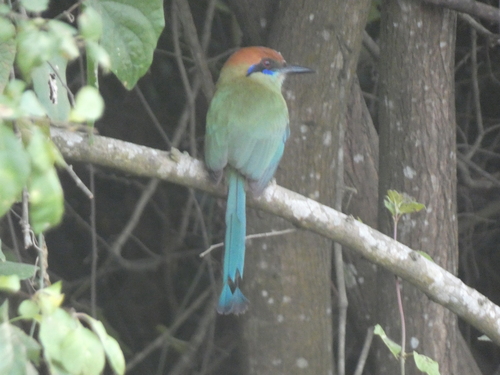 Russet-crowned MotmotMomotus mexicanusVoice: The russet-crowned motmot produces a low "krrp", "krrup", or "kru, krr-up" which is strung together, making a longer call.
 Trinidad MotmotMomotus bahamensisThe Trinidad motmot is much more deeply and uniformly rufous below than other species in Momotus.
Side by side: Amazonian Motmot vs Lesson's Motmot · Amazonian Motmot vs Andean Motmot · Amazonian Motmot vs Whooping Motmot · Amazonian Motmot vs Russet-crowned Motmot · Amazonian Motmot vs Trinidad Motmot
Learn the Amazonian Motmot in the BeakBrain App
Photo and call practice. Coming soon to iPhone and Android.
Play today's Daily BirdEvery photo and recording on this page is credited to its author under the licence shown. Spotted a problem with this page, or have a better photo? Contribute.