Learn what every symbol on the card means.Full credits and sources at beakbrain.com/symbols
 GrasslandDomed nestTiny · 12 g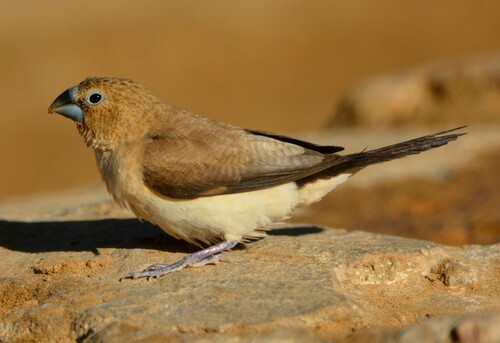


ID tip
The African silverbill is approximately 10 cm (3.9 in) in length with a long black pointed tail. The adult has a stubby silver-blue bill, finely vermiculated light-brown upper parts, whitish underparts, black rump and black wings. The sexes are similar, but immatures lack the vermiculations. This species has a tseep call and a trilling song. The contact call of the male is a single tseep while the female is a double noted tsiptsip. Birds in flight keep up a constant tseep tseep tseep. The subspecies E. c. orientalis is darker on the face and upperparts than the other subspecies.
Text from Wikipedia, licensed CC BY-SA 4.0.
When to see the African Silverbill
One bar for each month, and every month is filled: this bird is recorded here in all twelve. The wide bar is January, the month with the most records.
Where to see the African Silverbill
The map shades 25 countries with regular records, and 3 more in a lighter tone where the bird turns up only as a stray. Everything unshaded has no records. Countries are listed below the map.
Recorded as a rare visitor in Sierra Leone, Spain, Martinique.
About the African Silverbill
The African silverbill is a small passerine bird formerly considered conspecific with the Asian species Indian silverbill,. This estrildid finch is a common resident breeding bird in dry savanna habitat, south of the Sahara Desert. This species has also been introduced to other countries such as Portugal, Qatar and United States.
Text adapted from Wikipedia, licensed CC BY-SA 4.0.
Easily confused with

Side by side: African Silverbill vs Indian Silverbill
Learn the African Silverbill in the BeakBrain App
Photo and call practice. Coming soon to iPhone and Android.
Play today's Daily BirdEvery photo and recording on this page is credited to its author under the licence shown. Spotted a problem with this page, or have a better photo? Contribute.