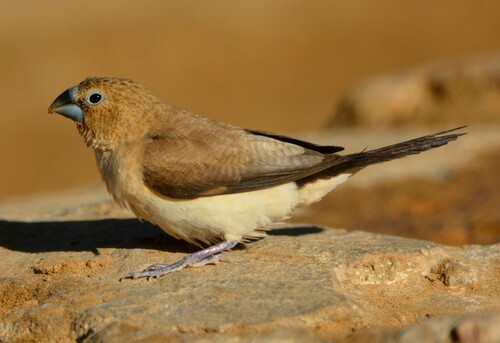
African Silverbill
Euodice cantans
The African silverbill is approximately 10 cm (3.9 in) in length with a long black pointed tail. The adult has a stubby silver-blue bill, finely vermiculated light-brown upper parts, whitish underparts, black rump and black wings. The sexes are similar, but immatures lack the vermiculations. This species has a tseep call and a trilling song. The contact call of the male is a single tseep while the female is a double noted tsiptsip. Birds in flight keep up a constant tseep tseep tseep. The subspecies E. c. orientalis is darker on the face and upperparts than the other subspecies.
ID text from Wikipedia, CC BY-SA 4.0

Indian Silverbill
Euodice malabarica
The adult Indian silverbill is 11–11.5 cm long and has a conical silver-grey bill, buff-brown upperparts, white underparts, buffy flanks and dark wings. The tail is black and the wings are dark contrasting with a white rump. The sexes are similar, but immatures have buff underparts and a shorter tail. The tail appears pointed as the length of the feathers reduces from the centre outwards. It feeds mainly on seeds, but also takes insects and has been known to visit nectar bearing flowers, such as those of Erythrina trees.
ID text from Wikipedia, CC BY-SA 4.0
Where you might meet both
Learn this pair in the BeakBrain App
Photo and call practice. Coming soon to iPhone and Android.
Play today's Daily BirdPhotos and recordings are credited to their authors under the licence shown. Full profiles: African Silverbill and Indian Silverbill.