Learn what every symbol on the card means.Full credits and sources at beakbrain.com/symbols
 ForestSmall · 38 g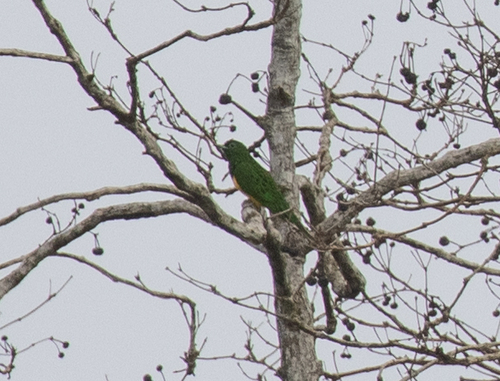
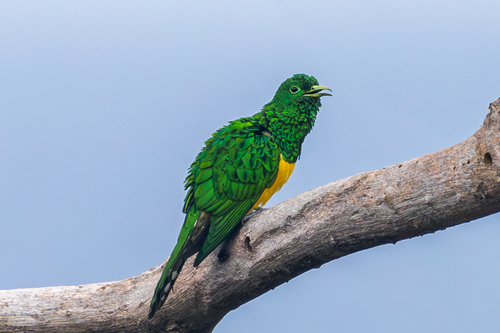
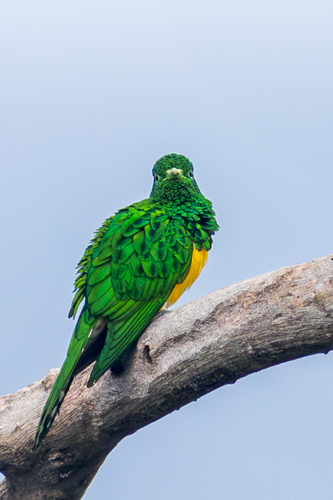


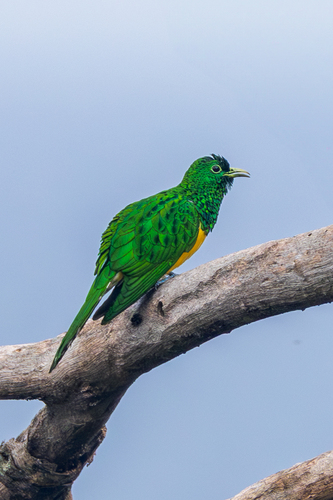
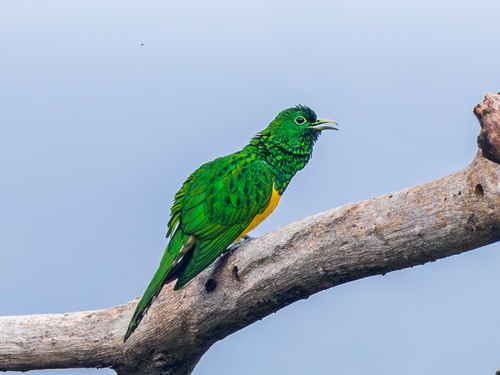
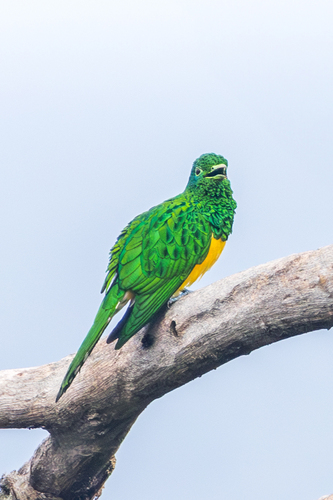
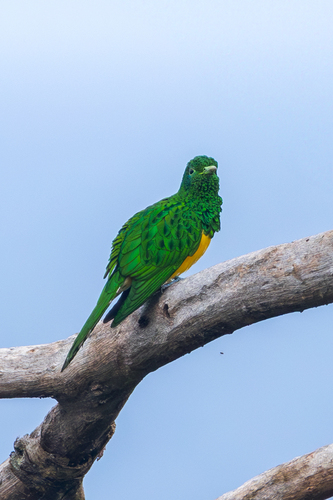
ID tip
The African emerald cuckoo is sexually dimorphic. The males have a green back and head with a yellow breast. Females are barred green and brown on their backs and green and white on their breasts. The African emerald cuckoo can also be identified by its call, a four-note whistle with the mnemonic device of "Hello Ju-dy."
Text from Wikipedia, licensed CC BY-SA 4.0.
When to see the African Emerald Cuckoo
One bar for each month. Filled bars are the 11 months with records; pale bars are months with none. The wide bar is November, the month with the most records.
Where to see the African Emerald Cuckoo
The map shades 29 countries with regular records, and 2 more in a lighter tone where the bird turns up only as a stray. Everything unshaded has no records. Countries are listed below the map.
Recorded as a rare visitor in South Sudan, Togo.
About the African Emerald Cuckoo
The African emerald cuckoo is a species of cuckoo that is native to Africa.
Text adapted from Wikipedia, licensed CC BY-SA 4.0.
Easily confused with
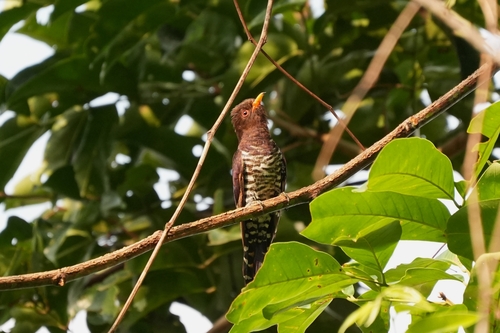 Violet CuckooChrysococcyx xanthorhynchusThe males have glossy violet feathers on the head and upper parts of the body.
 Asian Emerald CuckooChrysococcyx maculatusThe Asian emerald cuckoo grows to a length of about 18 cm (7 in).
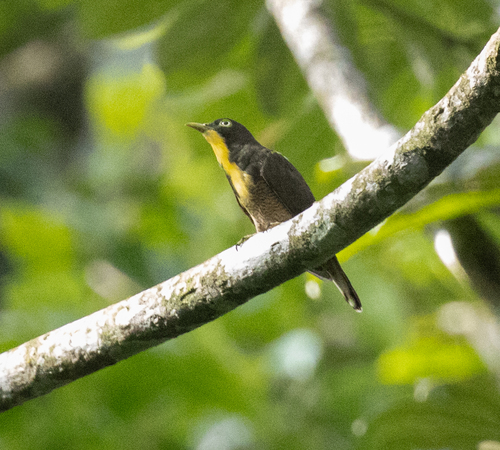 Yellow-throated CuckooChrysococcyx flavigularisThe yellow-throated cuckoo is a species of cuckoo in the family Cuculidae.
Side by side: African Emerald Cuckoo vs Diederik Cuckoo · African Emerald Cuckoo vs Klaas's Cuckoo · African Emerald Cuckoo vs Lesser Ground Cuckoo · African Emerald Cuckoo vs Violet Cuckoo · African Emerald Cuckoo vs Asian Emerald Cuckoo
Learn the African Emerald Cuckoo in the BeakBrain App
Photo and call practice. Coming soon to iPhone and Android.
Play today's Daily BirdEvery photo and recording on this page is credited to its author under the licence shown. Spotted a problem with this page, or have a better photo? Contribute.