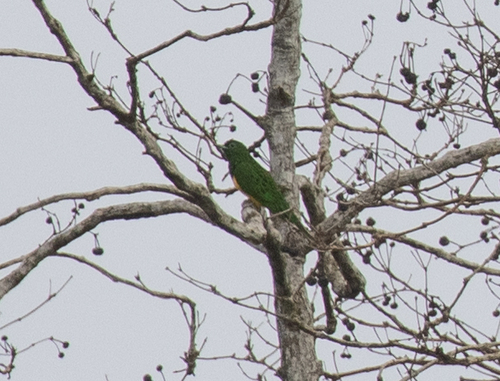
African Emerald Cuckoo
Chrysococcyx cupreus
The African emerald cuckoo is sexually dimorphic. The males have a green back and head with a yellow breast. Females are barred green and brown on their backs and green and white on their breasts. The African emerald cuckoo can also be identified by its call, a four-note whistle with the mnemonic device of "Hello Ju-dy."
ID text from Wikipedia, CC BY-SA 4.0

Diederik Cuckoo
Chrysococcyx caprius
The diederik cuckoo is a smallish cuckoo at 18 to 20 cm. Adult males are glossy green above with copper-sheened areas on the back and whitish underparts. They have a broken white eye-stripe and a short, green malar stripe. All remiges have three to four white spots on the inner vanes. The four green outer tail feathers are tipped white, and the outermost pair are spotted white on both vanes. Females show more copper above, and have coppery barring on the flanks. The underparts are often washed brownish. Juveniles have a red bill, streaky throat and a white wing-bar.
ID text from Wikipedia, CC BY-SA 4.0
Where you might meet both
And 4 more countries.
Learn this pair in the BeakBrain App
Photo and call practice. Coming soon to iPhone and Android.
Play today's Daily BirdPhotos and recordings are credited to their authors under the licence shown. Full profiles: African Emerald Cuckoo and Diederik Cuckoo.