Learn what every symbol on the card means.Full credits and sources at beakbrain.com/symbols
 ForestCavity nestTiny · 10 g


ID tip
The African dusky flycatcher is 13 cm (5.1 in) long and weighs around 11 g (0.39 oz). Its upperparts are plain brown, with the only facial marking being an indistinct narrow eye-ring. The chin is plain pale grey, and the rest of the underparts are grey-brown with indistinct streaks. The short, straight, laterally flattened bill is black, the legs and feet are grey, and the eyes are brown. The sexes are similar, but the juvenile is spotted with buff above, and is whitish spotted with brown below.
Text from Wikipedia, licensed CC BY-SA 4.0.
When to see the African Dusky Flycatcher
One bar for each month, and every month is filled: this bird is recorded here in all twelve. The wide bar is July, the month with the most records.
Where to see the African Dusky Flycatcher
The map shades 19 countries with regular records. Everything unshaded has no records. Countries are listed below the map.
About the African Dusky Flycatcher
The African dusky flycatcher, also known as the dusky-brown flycatcher or dusky alseonax, is a small passerine bird of the Old World flycatcher family, Muscicapidae. It is a resident breeder in elevated areas of Sub-Saharan Africa. It is very common in its woodland habitat, which includes riverine forests, evergreen forest edges and clearings, especially near water bodies such as lakes, dams and streams, and well-wooded suburban gardens.
Text adapted from Wikipedia, licensed CC BY-SA 4.0.
Easily confused with
 Dark-sided FlycatcherMuscicapa sibiricaThe dark-sided flycatcher is 13 to 14 cm (5.1 to 5.5 in) in overall length.
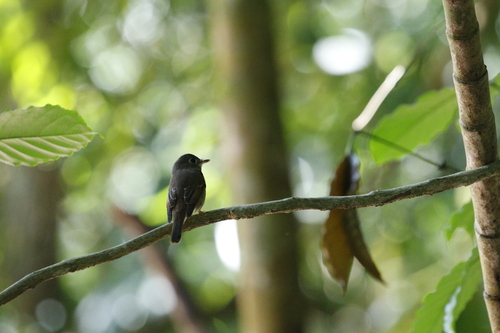 Brown-breasted FlycatcherMuscicapa muttuiThe brown-breasted flycatcher is 13–14 cm in length and weighs between 10 and 14 g.
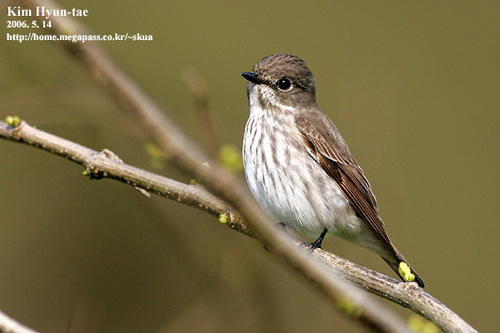 Grey-streaked FlycatcherMuscicapa griseistictaBradshaw, C.; Jepson, P. J.; Lindsey, N. J. (1991).
Side by side: African Dusky Flycatcher vs Spotted Flycatcher · African Dusky Flycatcher vs Asian Brown Flycatcher · African Dusky Flycatcher vs Dark-sided Flycatcher · African Dusky Flycatcher vs Brown-breasted Flycatcher · African Dusky Flycatcher vs Grey-streaked Flycatcher
Learn the African Dusky Flycatcher in the BeakBrain App
Photo and call practice. Coming soon to iPhone and Android.
Play today's Daily BirdEvery photo and recording on this page is credited to its author under the licence shown. Spotted a problem with this page, or have a better photo? Contribute.