Learn what every symbol on the card means.Full credits and sources at beakbrain.com/symbols
 WetlandCup nestMedium · 119 g


ID tip
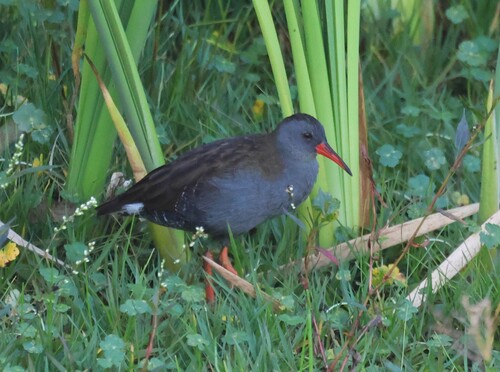
The African crake is a smallish crake, 20–23 cm (7.9–9.1 in) long with a 40–42 cm (16–17 in) wingspan. The male has blackish upperparts streaked with olive-brown, apart from the nape and hindneck which are plain pale brown; there is a white streak from the base of the bill to above the eye. The sides of the head, foreneck, throat and breast are bluish-grey, the flight feathers are dark brown, and the flanks and sides of the belly are barred black and white. The eye is red, the bill is reddish, and the legs and feet are light brown or grey. Voice: Like other rails, this species has a wide range of vocalisations. The male's territorial and advertising call is a series of rapid grating krrr notes repeated two or three times a second for several minutes. It is given most often in the breeding season, usually early or late in the day, but sometimes continues after dark or starts before dawn.
Text from Wikipedia, licensed CC BY-SA 4.0.
When to see the African Crake
One bar for each month. Filled bars are the 10 months with records; pale bars are months with none. The wide bar is January, the month with the most records.
Where to see the African Crake
The map shades 26 countries with regular records, and 8 more in a lighter tone where the bird turns up only as a stray. Everything unshaded has no records. Countries are listed below the map.
Recorded as a rare visitor in Spain, Portugal, Gambia, Senegal, Burkina Faso, Ethiopia, São Tomé & Príncipe, Togo.
About the African Crake
The African crake is a small- to medium-size ground-living bird in the rail family, found in most of central to southern Africa. It is seasonally common in most of its range other than the rainforests and areas that have low annual rainfall. This crake is a partial migrant, moving away from the equator as soon as the rains provide sufficient grass cover to allow it to breed elsewhere. There have been a few records of vagrant birds reaching Atlantic islands. This species nests in a wide variety of grassland types, and agricultural land with tall crops may also be used.
Text adapted from Wikipedia, licensed CC BY-SA 4.0.
Easily confused with
 Bogota RailRallus semiplumbeusThe Bogotá rail is a typical member of the genus Rallus, with a long and slightly decurved bill, a plump body, and a short tail.
 South Island TakahePorphyrio hochstetteriThe South Island takahē is the largest living member of the family Rallidae.
 Allen's GallinulePorphyrio alleniThey are similar in size to the only slightly larger water rail.
Side by side: African Crake vs Bogota Rail · African Crake vs South Island Takahe · African Crake vs Allen's Gallinule
Learn the African Crake in the BeakBrain App
Photo and call practice. Coming soon to iPhone and Android.
Play today's Daily BirdEvery photo and recording on this page is credited to its author under the licence shown. Spotted a problem with this page, or have a better photo? Contribute.