Learn what every symbol on the card means.Full credits and sources at beakbrain.com/symbols
 WoodlandTiny · 10 g
ID tip
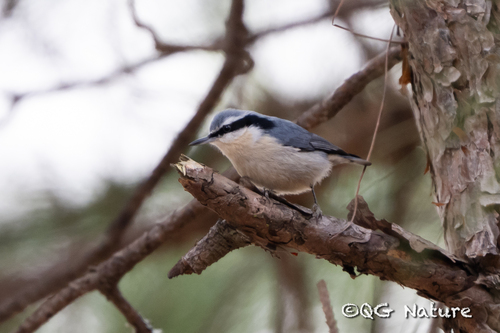
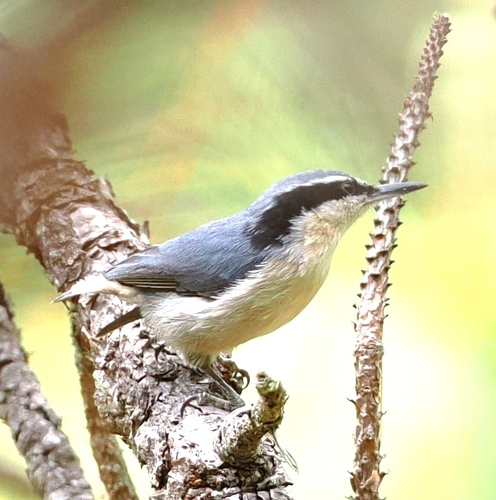
The upperparts of the Yunnan nuthatch are blue-grey, including the calotte, despite being separated from the upper mantle by a paler area. It has a thin white eyebrow, which extends to the forehead and surmounts a black eyestripe, which widens noticeably on the back, on the sides of the mantle. The eye has a fine white circle around it, and it has a white cheek and throat. The underparts are plain and pale, pinkish buff. The beak is thin and pointed and the almost straight culmen can give the impression that the tip of the beak is coming up. Voice: The Yunnan nuthatch is a fairly noisy bird, and typically makes many individual sounds: nit, kni, tit, pit, or a low and nasal toik. Its call, nit, is repeated in sets lasting four to ten seconds of five to six repetitions per second, producing a kni-kni-kni, kit-kit-kit, pi-pi-pi, or a nasal niew-niew-niew sound.
Text from Wikipedia, licensed CC BY-SA 4.0.
When to see the Yunnan Nuthatch
One bar for each month. Filled bars are the 10 months with records; pale bars are months with none. The wide bar is January, the month with the most records.
Where to see the Yunnan Nuthatch
The map shades 2 countries with regular records. Everything unshaded has no records. Countries are listed below the map.
About the Yunnan Nuthatch
The Yunnan nuthatch is a bird species in the nuthatch family Sittidae. It was first described by William Robert Ogilvie-Grant in 1900 based on a male holotype. It is a small nuthatch, measuring 12 centimetres (4.7 in) in length on average and weighs between 7.5 and 13 grams. The grey-blue upperparts contrast with the light, smooth, buffy lowerparts. It has a fine white eyebrow above a black eyestripe, which is distinct when the plumage is fresh, and exhibits a small degree of sexual dimorphism. A noisy bird, it produces simple, nasal sounds, sometimes in repetitive series.
Text adapted from Wikipedia, licensed CC BY-SA 4.0.
Easily confused with
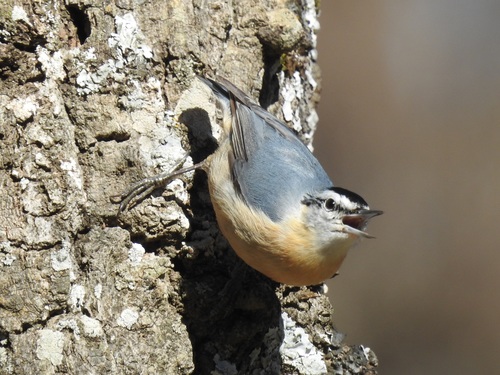 Algerian NuthatchSitta ledantiThe Algerian nuthatch is a medium-sized nuthatch; it measures between 11.5 cm (4.5 in) and 12.5 cm (4.9 in), and weighs about 18 grams (0.63 oz).
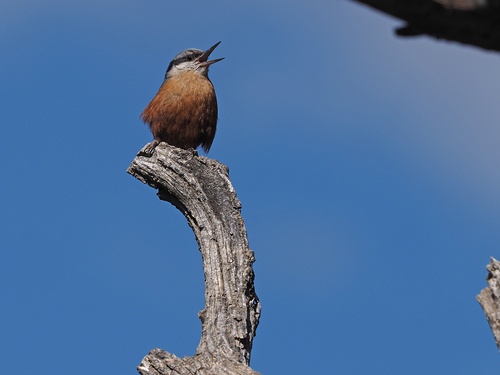 Kashmir NuthatchSitta cashmirensisThis bird measures 14 cm (5.5 in) long and has mostly grey upper parts, reddish underparts and a pale throat and chin.
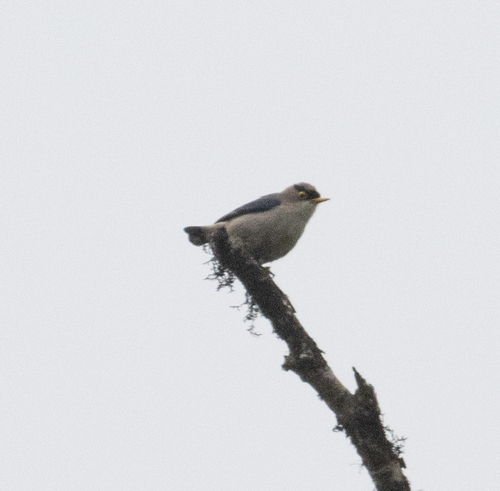 Yellow-billed NuthatchSitta solangiaeThe yellow-billed nuthatch is a species of bird in the family Sittidae.
Learn the Yunnan Nuthatch in the BeakBrain App
Photo and call practice. Coming soon to iPhone and Android.
Play today's Daily BirdEvery photo and recording on this page is credited to its author under the licence shown. Spotted a problem with this page, or have a better photo? Contribute.