Learn what every symbol on the card means.Full credits and sources at beakbrain.com/symbols
 ForestDomed nestSmall · 21 g


What the Wrenthrush sounds like

ID tip
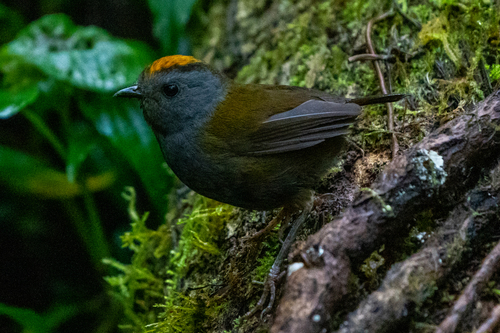
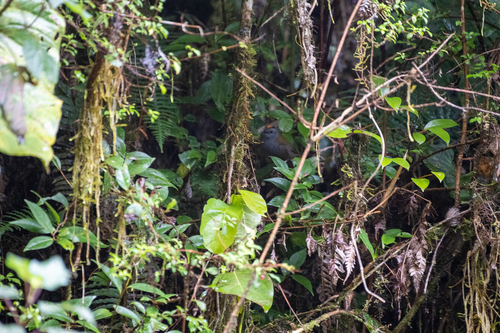
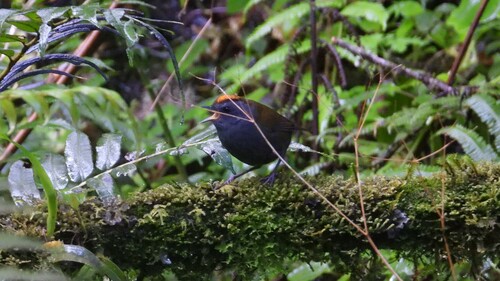
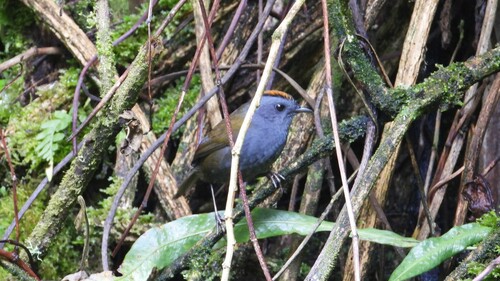
The wrenthrush is 10 to 11.5 cm (3.9 to 4.5 in) long and weighs about 21 g (0.74 oz). It is short-tailed and rather plump, with a short thin bill somewhat like that of a Parulidae warbler. The sexes are alike. Adults have a large yellow-orange patch with black borders on their crown. Their face and the sides of their neck are leaden gray. Their upperparts, tail, and flanks are dull olive bronze. Their underparts are leaden gray with an olive tinge to the undertail coverts. Juveniles do not have the orange crown and their upperparts are more brownish than those of adults. Voice: Both sexes of wrenthrush sing, and often as a duet. They are more vocal during the breeding season, and mostly sing at dawn and dusk though they can be heard throughout the day. Their primary song is described as "ssee-del-deet with emphasis on the ending, deet", and it may be sung in a series for several minutes. Their primary call is "a thin pseee".
Text from Wikipedia, licensed CC BY-SA 4.0.
When to see the Wrenthrush
One bar for each month, and every month is filled: this bird is recorded here in all twelve. The wide bar is March, the month with the most records.
Where to see the Wrenthrush
The map shades 2 countries with regular records. Everything unshaded has no records. Countries are listed below the map.
About the Wrenthrush
The wrenthrush or zeledonia, is a unique species of nine-primaried oscine, endemic to the Talamancan montane forests.
Text adapted from Wikipedia, licensed CC BY-SA 4.0.
Learn the Wrenthrush in the BeakBrain App
Photo and call practice. Coming soon to iPhone and Android.
Play today's Daily BirdEvery photo and recording on this page is credited to its author under the licence shown. Spotted a problem with this page, or have a better photo? Contribute.