Learn what every symbol on the card means.Full credits and sources at beakbrain.com/symbols
 ForestCavity nestHuge · 2.2 kg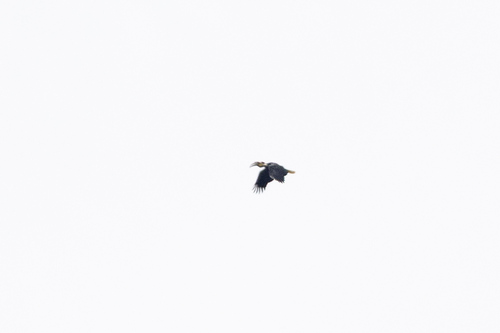
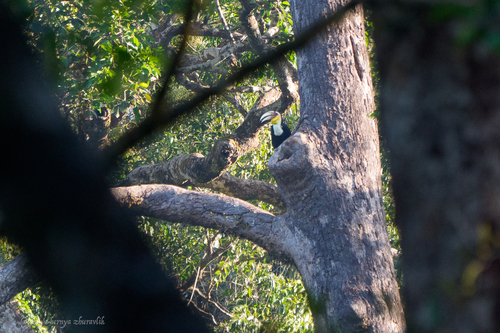
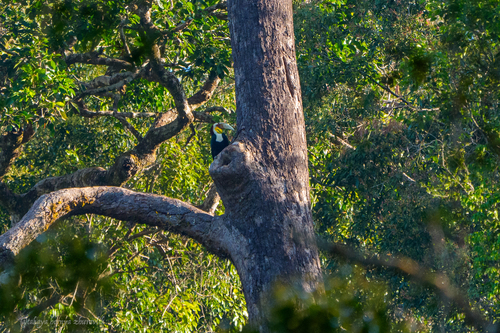
ID tip
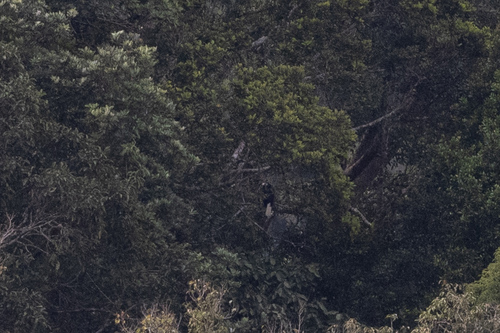
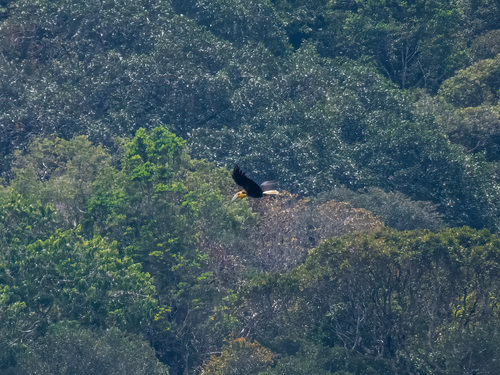
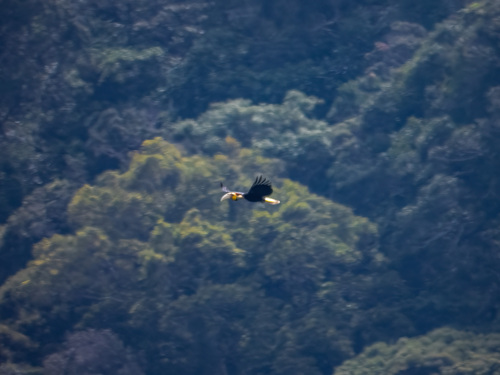
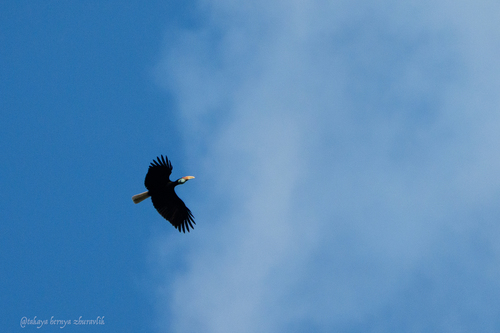
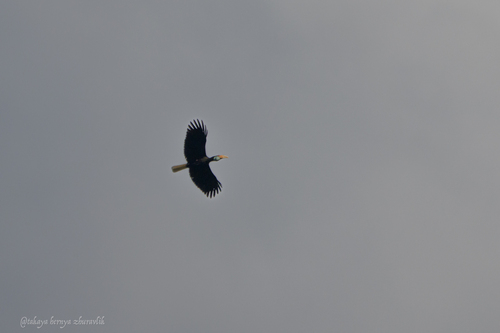
The wreathed hornbill is black with black legs and feet, but has a pale yellow bill, bare reddish skin around the eyes, a black band around the gular skin and a white tail. The female's gular skin is blue, whereas the male's is bright yellow; his neck is white and his nape dark reddish passing into black. Sexual dimorphism in the colouration of plumage and inflatable gular skin is less pronounced in young wreathed hornbills, but becomes more apparent as both sexes mature. It is a medium-sized bird with a body length of 75 to 90 cm (30 to 35 in); adult males weigh from 1.68 to 3.65 kg (3. Voice: The main call of the wreathed hornbill is a loud double yelp that has been described to sound like "coo-cuk" or "wuff-wurff". This call is short and typically repeated in a sequence of three or more from a perching position or during flight. The second part of the call is higher pitched and louder than the first and can be heard from farther distances.
Text from Wikipedia, licensed CC BY-SA 4.0.
When to see the Wreathed Hornbill
One bar for each month, and every month is filled: this bird is recorded here in all twelve. The wide bar is March, the month with the most records.
Where to see the Wreathed Hornbill
The map shades 11 countries with regular records. Everything unshaded has no records. Countries are listed below the map.
About the Wreathed Hornbill
The wreathed hornbill is an Old World tropical bird of the hornbill family Bucerotidae, also called bar-pouched wreathed hornbill due to its distinctive blue-black band on its lower throat sac. It is named after its characteristic long, curved bill that develops ridges, or wreaths, on the casque of the upper mandible in adults. Males are black with a rufous crown, a white upper breast and face, and a yellow featherless throat. Females are uniformly black with a blue throat and are slightly smaller than males.
Text adapted from Wikipedia, licensed CC BY-SA 4.0.
Easily confused with
 Blyth's HornbillRhyticeros plicatusUp to 91 cm (36 in) in length, the adult male has mainly black plumage with a golden or orange-buff head, white throat and a white tail.
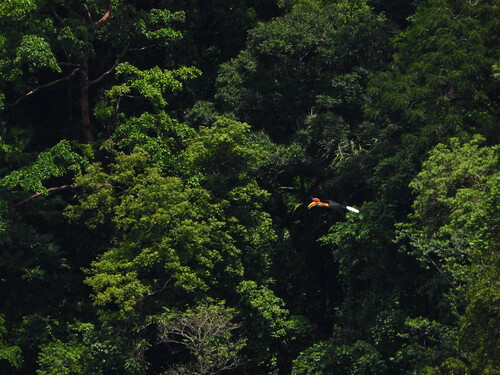 Knobbed HornbillRhyticeros cassidixThis is a large black hornbill with a yellow bill, white tail feathers, pale blue skin around eye, blackish feet and bare dark blue throat.
 Plain-pouched HornbillRhyticeros subruficollisThe plain-pouched hornbill is a species of hornbill in the family Bucerotidae.
Side by side: Blyth's Hornbill vs Wreathed Hornbill
Learn the Wreathed Hornbill in the BeakBrain App
Photo and call practice. Coming soon to iPhone and Android.
Play today's Daily BirdEvery photo and recording on this page is credited to its author under the licence shown. Spotted a problem with this page, or have a better photo? Contribute.