Learn what every symbol on the card means.Full credits and sources at beakbrain.com/symbols
 RockyCavity nestSmall · 32 g


ID tip
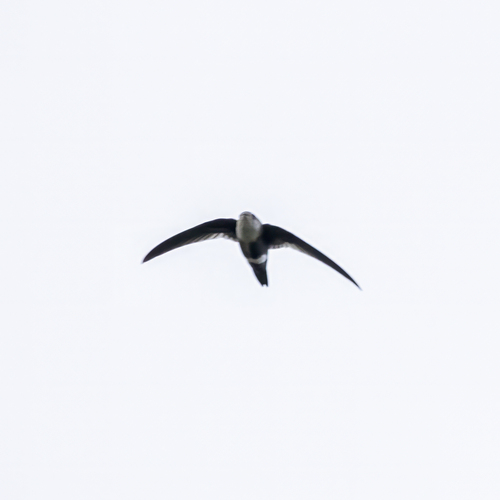
The white-throated swift is medium-sized bird that is primarily black and white. Its back and wings are blackish-brown or black, and its breast, belly, chin, and throat are white. In newly molted adults, the dark feathers may have a slight greenish sheen, though this is rarely observable in the field. Sexes cannot be distinguished by plumage. Juvenile (first basic) plumage is similar to adult (definitive basic) plumage, but with the feathers on juveniles' heads and necks appearing duller and paler. Voice: White-throated swifts make vocalizations while in the air that are described as "staccato chattering", and may also make a sharp one- or two-note call or a shrill drawn-out "scree" call. In the morning and evening, "twittering" sounds may be made at their roost sites. Additionally, juveniles may make begging sounds that are higher-pitched versions of the adult's shrill scree call.
Text from Wikipedia, licensed CC BY-SA 4.0.
When to see the White-throated Swift
One bar for each month. Filled bars are the 10 months with records; pale bars are months with none. The wide bar is May, the month with the most records.
Where to see the White-throated Swift
The map shades 6 countries with regular records. Everything unshaded has no records. Countries are listed below the map.
About the White-throated Swift
The white-throated swift is a swift of the family Apodidae native to western North America, south to cordilleran western Honduras. Its coastal range extends as far north as Northern California, while inland it has migratory populations found throughout the Great Basin and Rocky Mountain regions, ranging as far north as southern British Columbia. White-throated swifts are found in open areas near cliffs, rock faces, or man-made structures, where they roost. Swifts are social birds, and groups are often seen roosting and foraging for flying insects together.
Text adapted from Wikipedia, licensed CC BY-SA 4.0.
Easily confused with
 Andean SwiftAeronautes andecolusThe Andean swift is about 14 cm (5.5 in) long.
 White-tipped SwiftAeronautes montivagusThe white-tipped swift is 12 to 13 cm (4.7 to 5.1 in) long and weighs 17 to 33 g (0.60 to 1.2 oz).
Side by side: Andean Swift vs White-throated Swift · White-throated Swift vs White-tipped Swift
Learn the White-throated Swift in the BeakBrain App
Photo and call practice. Coming soon to iPhone and Android.
Play today's Daily BirdEvery photo and recording on this page is credited to its author under the licence shown. Spotted a problem with this page, or have a better photo? Contribute.