Learn what every symbol on the card means.Full credits and sources at beakbrain.com/symbols
 ForestSmall · 19 g
ID tip
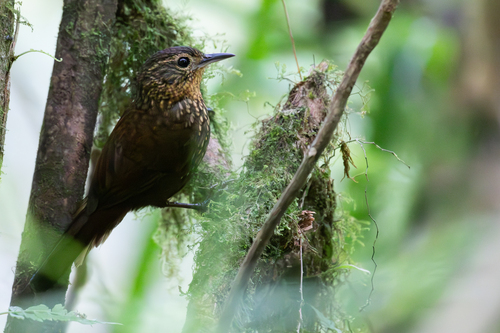
The white-throated barbtail is 14 to 15 cm (5.5 to 5.9 in) long. The sexes have the same plumage. Adults of the nominate subspecies have a whitish supercilium, brownish ear coverts, and whitish streaks on the side of the neck. Their crown is dark gray-brown with a blackish scalloped appearance. Their back, rump, and uppertail coverts are dark gray-brown with a rufous tinge. Their wings and tail are dark fuscous; the ends of the tail feathers lack barbs, giving a spiny appearance. Their throat and upper breast are whitish and the rest of their underparts dark brownish with whitish streaks. Voice: The subspecies of the white-throated barbtail have different songs. That of the nominate is "low-pitched, doubled or tripled, whistled notes or a bubbly series of low, soft, reedy whistles, we-whúr, we-whúr, we-héét". That of P. t. pariae is "a continuously repeated short, rapid, almost rattled but variable series of 2–6 subdued mellow notes, pu-dut...pu-du-du-dut...pu-du-dut....".
Text from Wikipedia, licensed CC BY-SA 4.0.
When to see the White-throated Barbtail
One bar for each month. Filled bars are the 9 months with records; pale bars are months with none. The wide bar is May, the month with the most records.
Where to see the White-throated Barbtail
The map shades 1 country with regular records. Everything unshaded has no records. Countries are listed below the map.
About the White-throated Barbtail
The white-throated barbtail is an Endangered species of bird in the Furnariinae subfamily of the ovenbird family Furnariidae. It is endemic to Venezuela.
Text adapted from Wikipedia, licensed CC BY-SA 4.0.
Easily confused with
Learn the White-throated Barbtail in the BeakBrain App
Photo and call practice. Coming soon to iPhone and Android.
Play today's Daily BirdEvery photo and recording on this page is credited to its author under the licence shown. Spotted a problem with this page, or have a better photo? Contribute.