Learn what every symbol on the card means.Full credits and sources at beakbrain.com/symbols
 ForestCup nestTiny · 14 g


ID tip
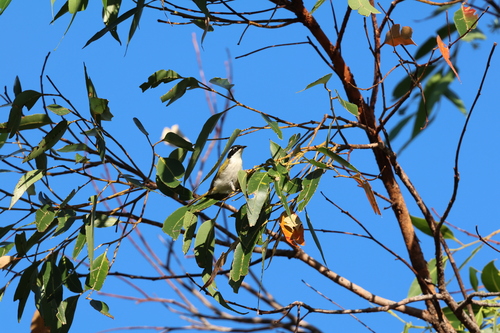
A mid-sized honeyeater at 13–15 cm (5–6 in) in length, it is olive-green above and white below, with a black head, nape and throat, a red patch over the eye, and a white crescent-shaped patch on the nape. It is thinner than other similar species. Juveniles have brownish crowns and an orange base of the bill. Its call is a mjerp mjerp.
Text from Wikipedia, licensed CC BY-SA 4.0.
When to see the White-naped Honeyeater
One bar for each month, and every month is filled: this bird is recorded here in all twelve. The wide bar is April, the month with the most records.
Where to see the White-naped Honeyeater
The map shades 1 country with regular records. Everything unshaded has no records. Countries are listed below the map.
About the White-naped Honeyeater
The white-naped honeyeater is a passerine bird of the honeyeater family Meliphagidae native to eastern Australia. Birds from southwestern Australia have been shown to be a distinct species, Gilbert's honeyeater, and the eastern birds are more closely related to the black-headed honeyeater of Tasmania. One of several similar species of black-headed honeyeaters in the genus Melithreptus, it dwells in dry sclerophyll eucalypt woodland. Its diet consists of nectar from various flowers, and it also feeds on insects.
Text adapted from Wikipedia, licensed CC BY-SA 4.0.
Easily confused with
 White-throated HoneyeaterMelithreptus albogularisThe adult white-throated honeyeater is 11.5 to 14.5 cm (4.5 to 5.7 in) long, with olive-green or yellow-green upperparts, yellower on the rump, and white throat and underparts, a black head, a blue-white patch of bare skin over the eye, and a white stripe across the nape.
 Brown-headed HoneyeaterMelithreptus brevirostrisA small honeyeater ranging from 13 to 15 cm (5.2–6 in) in length, it is olive-brown above and buff below, with a brown head, nape and throat, a cream or orange patch of bare skin over the eye, and a dull white crescent-shaped patch on the nape.
 Black-chinned HoneyeaterMelithreptus gularisA mid-sized honeyeater ranging from 14 to 16 cm (5.6–6.4 in) in length, it is olive-brown above and buff below, with a black head, nape and throat, with a bluish patch of bare skin over the eye and a white crescent-shaped patch on the nape.
Side by side: White-naped Honeyeater vs White-throated Honeyeater · Brown-headed Honeyeater vs White-naped Honeyeater · Black-chinned Honeyeater vs White-naped Honeyeater
Learn the White-naped Honeyeater in the BeakBrain App
Photo and call practice. Coming soon to iPhone and Android.
Play today's Daily BirdEvery photo and recording on this page is credited to its author under the licence shown. Spotted a problem with this page, or have a better photo? Contribute.