Learn what every symbol on the card means.Full credits and sources at beakbrain.com/symbols
 ForestPlatform nestLarge · 704 g


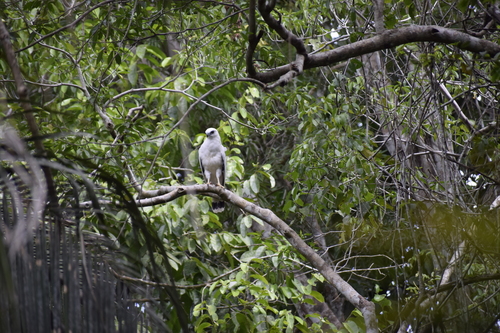
ID tip
The adult white hawk ranges from 46–56 cm (18–22 in) long with very broad wings and has a white head, body and underwings. The upper wings are black, and the very short tail is black with a broad white band. The bill is black and the legs are yellow. The sexes are similar, but females are larger and heavier—840 g (1.85 lb) compared to the male's 650 g (1.43 lb). Immature birds have extensive black spotting on the upperparts and dark-streaked whitish underparts. The call of the white hawk is a plaintive kerwee.
Text from Wikipedia, licensed CC BY-SA 4.0.
When to see the White Hawk
One bar for each month, and every month is filled: this bird is recorded here in all twelve. The wide bar is February, the month with the most records.
Where to see the White Hawk
The map shades 18 countries with regular records. Everything unshaded has no records. Countries are listed below the map.
About the White Hawk
The white hawk is a bird of prey breeding in the tropical New World of the family Accipitridae. Though it is commonly placed in the subfamily Buteoninae, the validity of this group is doubtful and currently under review.
Text adapted from Wikipedia, licensed CC BY-SA 4.0.
Easily confused with
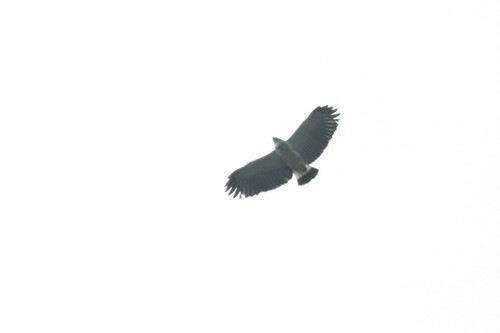 Grey-backed HawkPseudastur occidentalisThe grey-backed hawk is 45 to 52 cm (18 to 20 in) long with a 104 to 116 cm (41 to 46 in) wingspan.
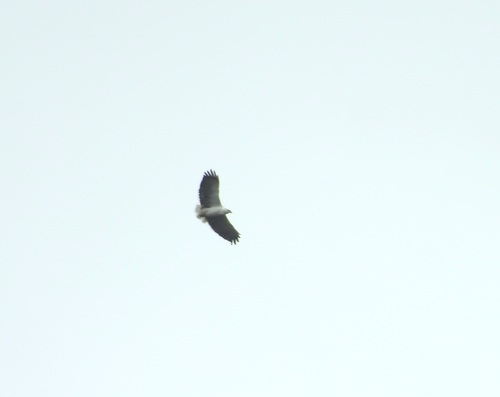 Mantled HawkPseudastur polionotusThe adult of this medium-sized hawk has a bulky appearance with broad "shoulders" relative to total length.
Side by side: Hooded Vulture vs White Hawk · Hook-billed Kite vs White Hawk
Learn the White Hawk in the BeakBrain App
Photo and call practice. Coming soon to iPhone and Android.
Play today's Daily BirdEvery photo and recording on this page is credited to its author under the licence shown. Spotted a problem with this page, or have a better photo? Contribute.