Learn what every symbol on the card means.Full credits and sources at beakbrain.com/symbols
 ForestMedium · 62 g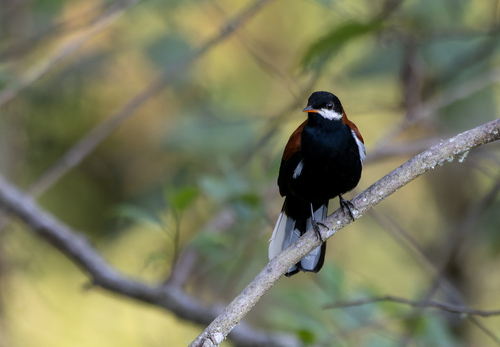
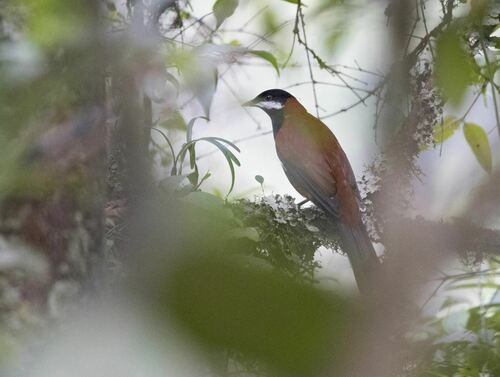
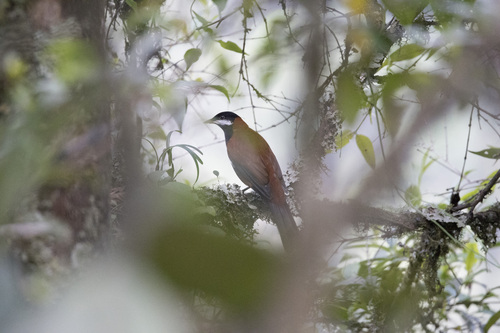
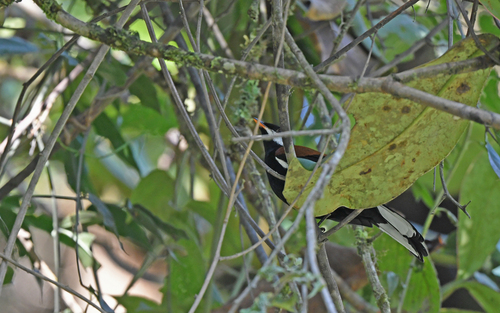
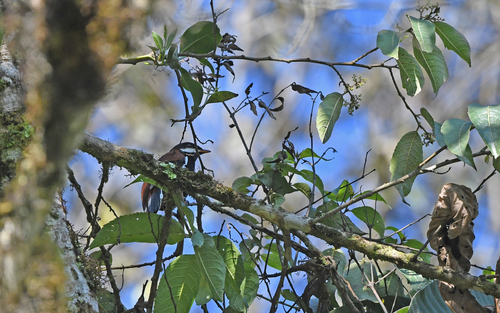
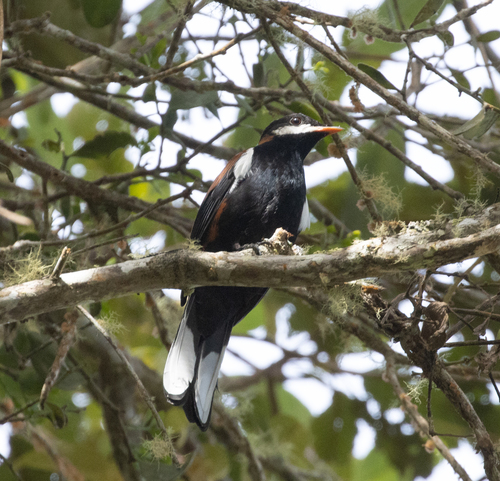
ID tip
The white-eared solitaire is 22 to 24 cm (8.7 to 9.4 in) long and weighs about 58 g (2.0 oz). Adult males have a large white patch from their bill through their ear coverts on an otherwise black head. They have a rich chestnut nape and upperparts with some white in the carpal area. Their wing coverts are rich chestnut and their flight feathers blackish with a wide white bar on the underside. Their tail is mostly blackish with white on the ends of the outer feathers. Their underparts are black. Adult females have a browner crown than males and some brown on their underparts. Voice: The white-eared solitaire's song is "a single, ringing, even note" that is repeated about every 10 to 20 seconds. In the more northerly part of its range the song "tends to be a little more musical, although sounds 'rusty' " and from Cuzco Department south is "flatter, buzzier, and more nasal: zzzeeee". Its calls are "a quiet dzz and a high, ringing tseee". Its alarm call is "a low growl".
Text from Wikipedia, licensed CC BY-SA 4.0.
When to see the White-eared Solitaire
One bar for each month. Filled bars are the 8 months with records; pale bars are months with none. The wide bar is October, the month with the most records.
Where to see the White-eared Solitaire
The map shades 2 countries with regular records. Everything unshaded has no records. Countries are listed below the map.
About the White-eared Solitaire
The white-eared solitaire is a species of bird in the family Turdidae, the thrushes. It is found in Bolivia and Peru.
Text adapted from Wikipedia, licensed CC BY-SA 4.0.
Easily confused with
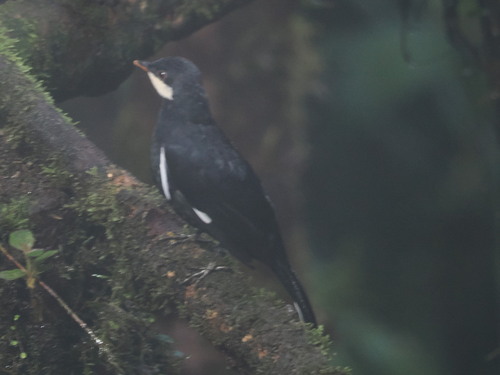
Side by side: Black Solitaire vs White-eared Solitaire
Learn the White-eared Solitaire in the BeakBrain App
Photo and call practice. Coming soon to iPhone and Android.
Play today's Daily BirdEvery photo and recording on this page is credited to its author under the licence shown. Spotted a problem with this page, or have a better photo? Contribute.