Learn what every symbol on the card means.Full credits and sources at beakbrain.com/symbols
 ForestCavity nestSmall · 50 g
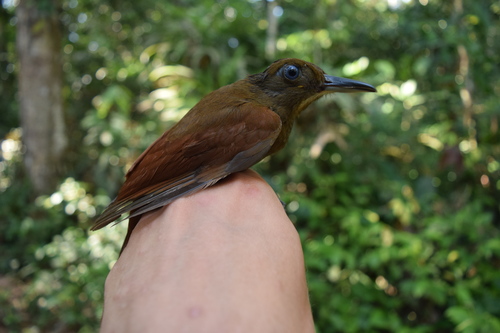
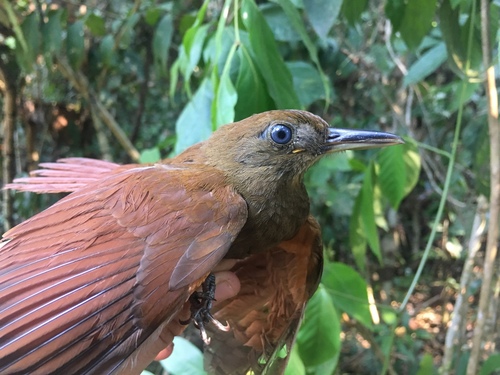
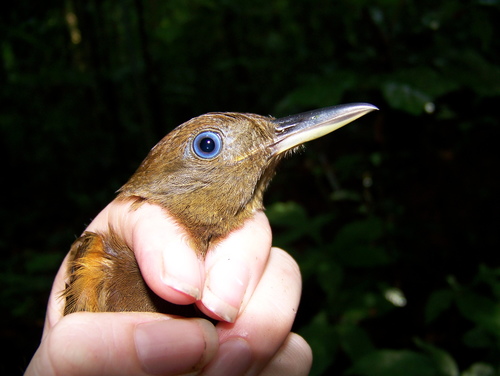
ID tip
The white-chinned woodcreeper is a medium-sized member of its genus with a shortish straight bill. It is 16 to 21 cm (6.3 to 8.3 in) long. Males weigh 28 to 54 g (0.99 to 1.9 oz) and females 29 to 54 g (1.0 to 1.9 oz). Subspecies D. m. merula and D. m. obidensis are significantly larger than the other five. In all subspecies the male and female have the same plumage. The nominate subspecies has mostly dark reddish brown upperparts with slightly redder wing coverts, flight feathers, and tail. A few flight feathers have dark brown tips. Voice: Subspecies D. m. merula and D. m. obidensis of the white-chinned woodcreeper sing "a series of 6-9 loud whistled notes...'kew, kew, kew, kew, kew, kewp' ". Their call is a "piercing 'deet-eet-ee' ". The songs of other subspecies have a lower pitch; in Colombia it has been described as "we, wi, di, dit" or "wi-wid-wid-di". Their calls include a "dit-it-it-it" or "tat-at-at".
Text from Wikipedia, licensed CC BY-SA 4.0.
When to see the White-chinned Woodcreeper
One bar for each month. Filled bars are the 10 months with records; pale bars are months with none. The wide bar is August, the month with the most records.
Where to see the White-chinned Woodcreeper
The map shades 9 countries with regular records. Everything unshaded has no records. Countries are listed below the map.
About the White-chinned Woodcreeper
The white-chinned woodcreeper is a species of bird in subfamily Dendrocolaptinae of the ovenbird family Furnariidae. It is found in Bolivia, Brazil, Colombia, Ecuador, French Guiana, Guyana, Peru, Suriname, and Venezuela.
Text adapted from Wikipedia, licensed CC BY-SA 4.0.
Easily confused with
 Plain-winged WoodcreeperDendrocincla turdinaThe plain-winged woodcreeper is 19 to 21 cm (7.5 to 8.3 in) long and weighs 23 to 45 g (0.81 to 1.6 oz).
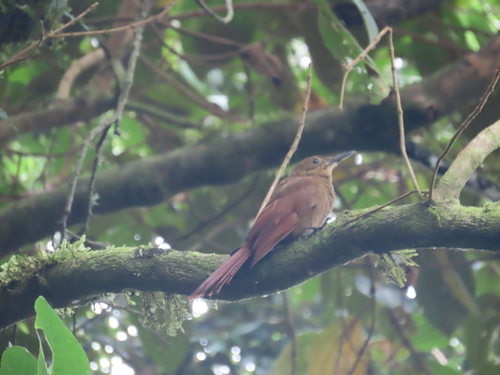 Tyrannine WoodcreeperDendrocincla tyranninaThe tyrannine woodcreeper is rather larger and heavier than most others of its genus.
 Ruddy WoodcreeperDendrocincla homochroaThe ruddy woodcreeper is 17.5 to 20.5 cm (6.9 to 8.1 in) long.
Learn the White-chinned Woodcreeper in the BeakBrain App
Photo and call practice. Coming soon to iPhone and Android.
Play today's Daily BirdEvery photo and recording on this page is credited to its author under the licence shown. Spotted a problem with this page, or have a better photo? Contribute.