Learn what every symbol on the card means.Full credits and sources at beakbrain.com/symbols
 GrasslandCavity nestMedium · 83 g


ID tip
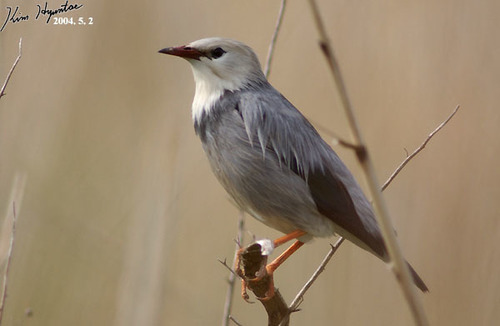
White-cheeked starlings are 24 cm in length. The adult male is mainly dark grey-brown with a paler belly and a whitish band across the rump. The head is blackish with whitish cheeks and forehead. There is a white border to the tail and white markings on the secondary wing feathers. The legs are pale orange and the bill is orange with a black tip. Adult females are similar to the males but paler and duller. The juvenile is brown with pale cheeks and rump and no black tip to the bill. The loud, monotonous call is a series of harsh, creaking notes.
Text from Wikipedia, licensed CC BY-SA 4.0.
When to see the White-cheeked Starling
One bar for each month. Filled bars are the 11 months with records; pale bars are months with none. The wide bar is May, the month with the most records.
Where to see the White-cheeked Starling
The map shades 16 countries with regular records, and 3 more in a lighter tone where the bird turns up only as a stray. Everything unshaded has no records. Countries are listed below the map.
About the White-cheeked Starling
The white-cheeked starling or grey starling is a passerine bird of the starling family. It is native to eastern Asia where it is a common and well-known bird in much of its range.
Text adapted from Wikipedia, licensed CC BY-SA 4.0.
Easily confused with
Learn the White-cheeked Starling in the BeakBrain App
Photo and call practice. Coming soon to iPhone and Android.
Play today's Daily BirdEvery photo and recording on this page is credited to its author under the licence shown. Spotted a problem with this page, or have a better photo? Contribute.