Learn what every symbol on the card means.Full credits and sources at beakbrain.com/symbols
 ShrublandCup nestSmall · 18 g


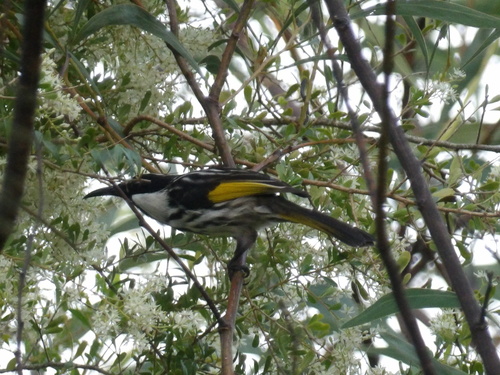
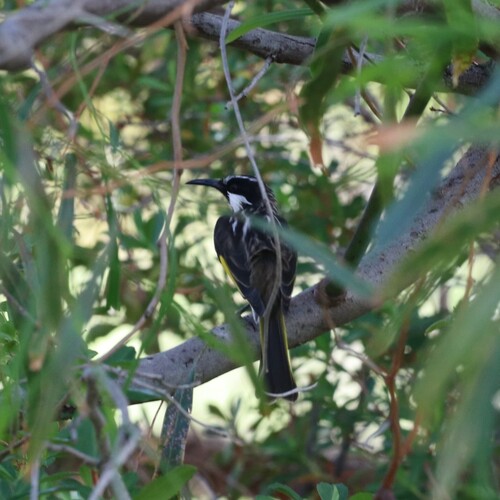
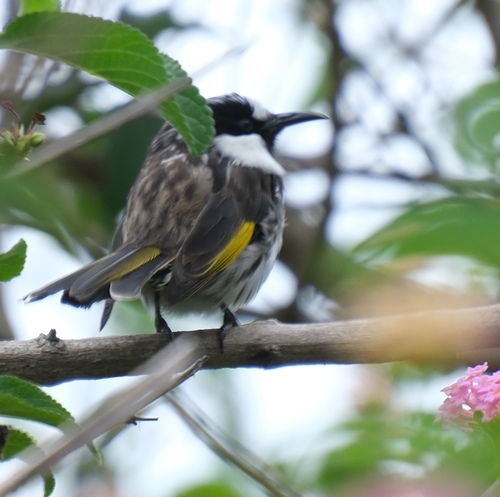
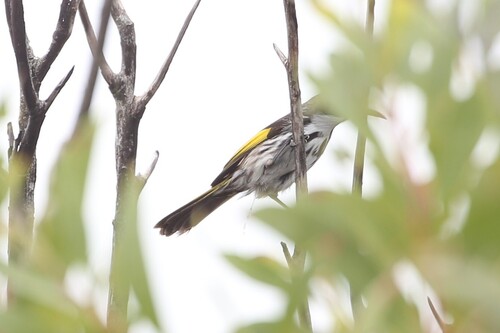

ID tip
The white-cheeked honeyeater is a medium-sized black and white honeyeater, with a long, sturdy bill that curves downwards. It has large bright-yellow tail and wing panels, with a large conspicuous white cheek-patch on a mainly black head. The eye is dark brown and it has a long, tapering, white brow-line. Young birds have a yellow gape and brow and the plumage is dusky or dull brownish. It is gregarious, active and noisy with swift, erratic flight. It is 16–20 cm (6.3–7.9 in) in length; males weigh 15.5–25 g (0.55–0.88 oz) and females 15.5–20 g (0.55–0.71 oz).
Text from Wikipedia, licensed CC BY-SA 4.0.
When to see the White-cheeked Honeyeater
One bar for each month, and every month is filled: this bird is recorded here in all twelve. The wide bar is August, the month with the most records.
Where to see the White-cheeked Honeyeater
The map shades 1 country with regular records. Everything unshaded has no records. Countries are listed below the map.
About the White-cheeked Honeyeater
The white-cheeked honeyeater is a species of honeyeater that inhabits the east coast and the south-west corner of Australia. It has a large white patch on its cheek, brown eyes, and a yellow panel on its wing.
Text adapted from Wikipedia, licensed CC BY-SA 4.0.
Easily confused with
 Crescent HoneyeaterPhylidonyris pyrrhopterusThe crescent honeyeater measures 14–17 centimetres (5.5–6.7 in) in length with a wingspan of 16–23 centimetres (6.3–9.1 in), and it weighs about 16 grams (0.56 oz).
 New Holland HoneyeaterPhylidonyris novaehollandiaeThe bird is around 18 cm (7.1 in) long and is mainly black, with a white iris, white facial tufts and yellow margins on its wing and tail feathers.
Side by side: New Holland Honeyeater vs White-cheeked Honeyeater · Striped Honeyeater vs White-cheeked Honeyeater · Crescent Honeyeater vs White-cheeked Honeyeater
Learn the White-cheeked Honeyeater in the BeakBrain App
Photo and call practice. Coming soon to iPhone and Android.
Play today's Daily BirdEvery photo and recording on this page is credited to its author under the licence shown. Spotted a problem with this page, or have a better photo? Contribute.