Learn what every symbol on the card means.Full credits and sources at beakbrain.com/symbols
 ForestCup nestSmall · 52 g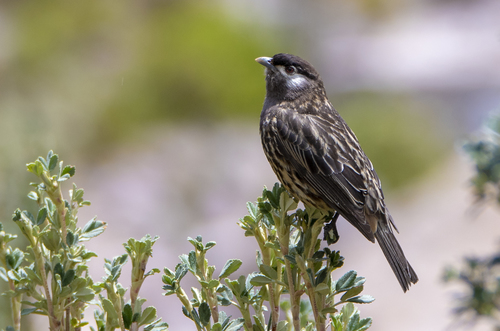
ID tip
The white-cheeked cotinga is about 21 cm (8.3 in) long and weighs 46 to 57 g (1.6 to 2.0 oz). The sexes have the same plumage. Adults have a dirty brown-black forehead, crown, and lores. Their ear coverts are white to silvery and the rest of their face dark ashy brown. Their nape is ochre with heavy black streaks. Their upperparts are blackish with ochre to buff streaks. Their throat is dark ashy brown. Their underparts are rich ochre with heavy blackish streaks on the upper breast and sides; the streaks are narrower on the lower breast and flanks and absent from the undertail coverts. Voice: As of August 2025 xeno-canto had four recordings of white-cheeked cotinga vocalizations; the Cornell Lab's Macaulay Library had 11 with much overlap. The white-cheeked cotinga's song is "a series of deep, burry accelerating quacks into a rising-falling chatter, slowing at the very end" djee-djee-DJEE-DJEE-djee'dje'dje'djer'r'r'r'r'dje'dje".
Text from Wikipedia, licensed CC BY-SA 4.0.
When to see the White-cheeked Cotinga
One bar for each month. Filled bars are the 10 months with records; pale bars are months with none. The wide bar is May, the month with the most records.
Where to see the White-cheeked Cotinga
The map shades 1 country with regular records. Everything unshaded has no records. Countries are listed below the map.
About the White-cheeked Cotinga
The white-cheeked cotinga is a Near Threatened species of bird in the family Cotingidae, the cotingas. It is endemic to Peru.
Text adapted from Wikipedia, licensed CC BY-SA 4.0.
Easily confused with
 Crimson FruitcrowHaematoderus militarisThe crimson fruitcrow is a large bird about 34 centimetres (13 in) long.
 Handsome FruiteaterPipreola formosaThe handsome fruiteater is 16 to 18 cm (6.3 to 7.1 in) long and weighs 32.5 to 49 g (1.1 to 1.7 oz).
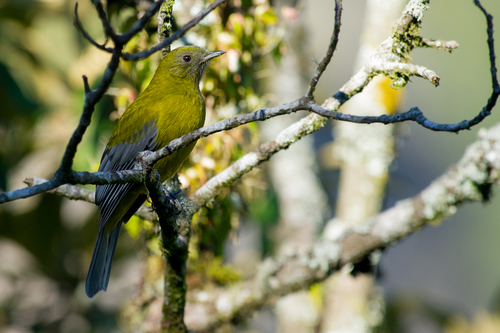 Grey-winged CotingaLipaugus conditusThe grey-winged cotinga is about 24 cm (9.4 in) long.
Learn the White-cheeked Cotinga in the BeakBrain App
Photo and call practice. Coming soon to iPhone and Android.
Play today's Daily BirdEvery photo and recording on this page is credited to its author under the licence shown. Spotted a problem with this page, or have a better photo? Contribute.