Learn what every symbol on the card means.Full credits and sources at beakbrain.com/symbols
 ForestPlatform nestMedium · 99 g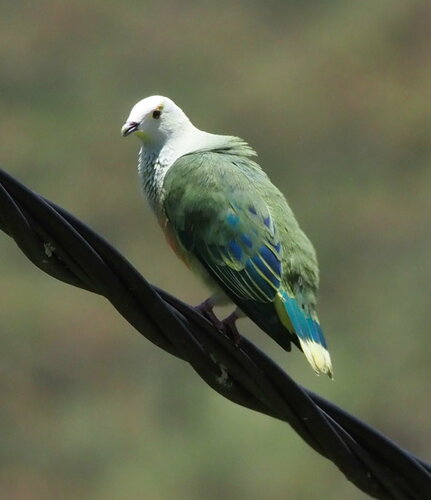
ID tip
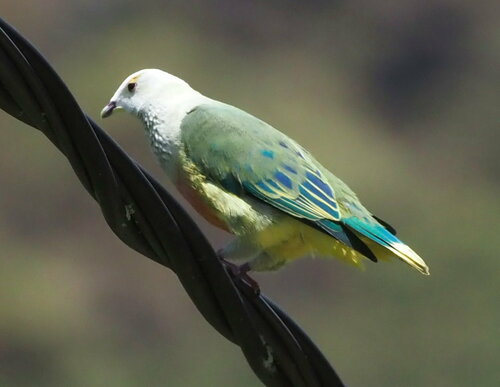
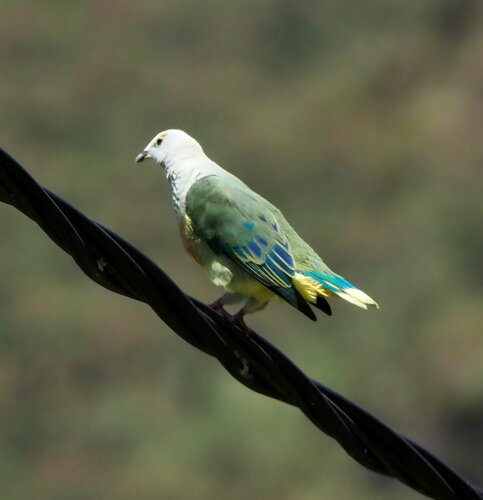
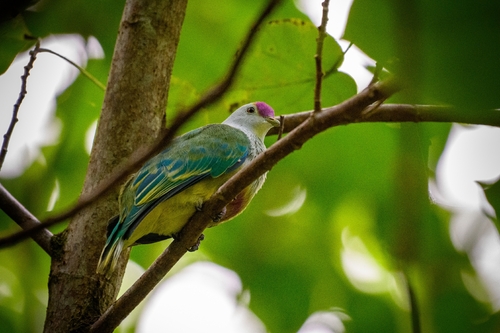
The white-capped fruit dove is a colourful bird with greenish wings that are marked with blue patches. Their belly is yellow but presents a bright red and orange patch at the middle point of their body; the yellow colours seem to get more vibrant towards the underside of their tail. Their throat is yellow with the same kind of tints as their belly. As their name suggests, they have a lighter white crown that extends all the way to their beak. Voice: Typical vocalizations of dove with the presence of "coo" sounds that rise in pitch and then get lower pitched. They are described as "mournful" sounding. The white-capped fruit dove produces long and slow vocalizations at first that can accelerate and get shorter as the call goes on.
Text from Wikipedia, licensed CC BY-SA 4.0.
When to see the White-capped Fruit Dove
One bar for each month. Filled bars are the 7 months with records; pale bars are months with none. The wide bar is May, the month with the most records.
Where to see the White-capped Fruit Dove
The map shades 1 country with regular records. Everything unshaded has no records. Countries are listed below the map.
About the White-capped Fruit Dove
The white-capped fruit dove, also called kuku locally, is a species of bird in the family Columbidae. It was described by French naturalist and surgeon Adolphe-Simon Neboux in 1840. It is endemic to the Marquesas Islands in French Polynesia. The name honours French admiral and botanist Abel Aubert du Petit-Thouars. Two subspecies exist on the islands, Ptilinopus d. dupetithouarsii and Ptilinopus d. viridior.
Text adapted from Wikipedia, licensed CC BY-SA 4.0.
Easily confused with
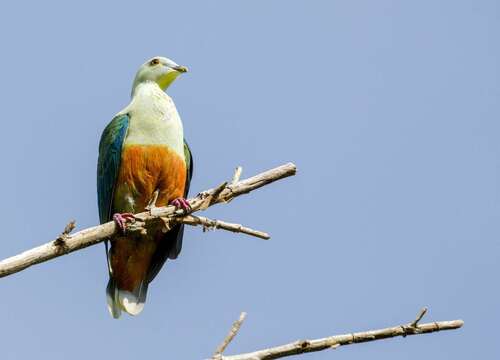 Silver-capped Fruit DovePtilinopus richardsiiThe silver-capped fruit dove is a species of bird in the family Columbidae.
Purple-capped Fruit DovePtilinopus ponapensisThe purple-capped fruit dove or Pohnpei fruit dove, is a species of bird in the family Columbidae found on Chuuk and Pohnpei in the Caroline Islands.
Silver-capped Fruit DovePtilinopus richardsiiThe silver-capped fruit dove is a species of bird in the family Columbidae.
Purple-capped Fruit DovePtilinopus ponapensisThe purple-capped fruit dove or Pohnpei fruit dove, is a species of bird in the family Columbidae found on Chuuk and Pohnpei in the Caroline Islands.
 Lilac-crowned Fruit DovePtilinopus rarotongensisThe lilac-crowned fruit dove, also known as the Rarotonga fruit-dove or Cook Islands fruit-dove, is one of over 50 species of Ptilinopus.
Learn the White-capped Fruit Dove in the BeakBrain App
Photo and call practice. Coming soon to iPhone and Android.
Play today's Daily BirdEvery photo and recording on this page is credited to its author under the licence shown. Spotted a problem with this page, or have a better photo? Contribute.