Learn what every symbol on the card means.Full credits and sources at beakbrain.com/symbols
 ShrublandCavity nestSmall · 22 g

ID tip
The brown treecreeper (Climacteris picumnus) is similar in appearance to the white-browed treecreeper; however, the brown treecreeper's breast streaks are duller and ear-covert streaking confined to rear coverts. In addition, the brown treecreeper's short shrill 'peep' calls differ greatly to that of the white-browed treecreeper's long 'prrrpt' insect-like calls.
Text from Wikipedia, licensed CC BY-SA 4.0.
When to see the White-browed Treecreeper
One bar for each month. Filled bars are the 9 months with records; pale bars are months with none. The wide bar is September, the month with the most records.
Where to see the White-browed Treecreeper
The map shades 1 country with regular records. Everything unshaded has no records. Countries are listed below the map.
About the White-browed Treecreeper
The white-browed treecreeper is the smallest of the Australo-papuan treecreepers and sole family member adapted to arid environments. The species foraging strategy involves climbing the trunks of trees in search of invertebrate prey on and under bark. Although some populations within the species range have declined, the species IUCN conservation status is of Least Concern.
Text adapted from Wikipedia, licensed CC BY-SA 4.0.
Easily confused with
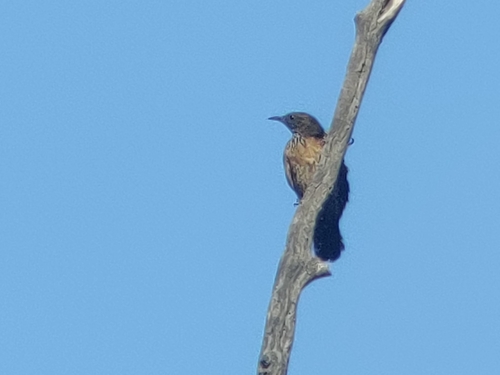 Black-tailed TreecreeperClimacteris melanurusVoice: It is most often heard giving a contact call, a loud, metallic chee-ting or ching, often singly or in repeated 1–2 second intervals.
 Rufous TreecreeperClimacteris rufusThe rufous treecreeper measures between 15–17cm from bill to tail and weighs 27-37 grams, with a wingspan of approximately 16-18cm.
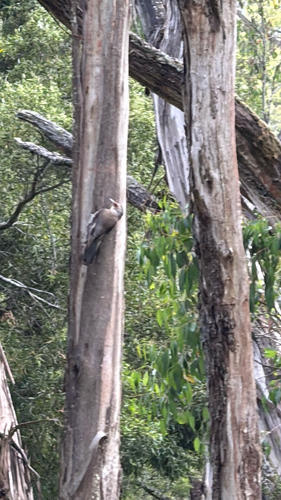 Red-browed TreecreeperClimacteris erythropsIt has a dark brown back and a red brow above its eye.
Side by side: Brown Treecreeper vs White-browed Treecreeper · Red-browed Treecreeper vs White-browed Treecreeper · Rufous Treecreeper vs White-browed Treecreeper · Black-tailed Treecreeper vs White-browed Treecreeper
Learn the White-browed Treecreeper in the BeakBrain App
Photo and call practice. Coming soon to iPhone and Android.
Play today's Daily BirdEvery photo and recording on this page is credited to its author under the licence shown. Spotted a problem with this page, or have a better photo? Contribute.