Learn what every symbol on the card means.Full credits and sources at beakbrain.com/symbols
 ForestCavity nestSmall · 19 g


ID tip
This flycatcher is about 13 centimetres (5.1 in) long and has a longish beak. It forages in the undergrowth in the shade of dense forest canopy where it makes aerial forays to capture insects. The male is indigo blue with ultramarine blue supercilium and forehead. The lores and face are dark grey. The belly is white and bordered by smoky grey wash. The female is olive brown above with whitish lores. The rufous throat and breast fades to white towards the belly. The female has a chestnut tail and can be told apart from other flycatchers like by the lack of the black and white tail pattern.
Text from Wikipedia, licensed CC BY-SA 4.0.
When to see the White-bellied Blue Flycatcher
One bar for each month. Filled bars are the 8 months with records; pale bars are months with none. The wide bar is February, the month with the most records.
Where to see the White-bellied Blue Flycatcher
The map shades 1 country with regular records. Everything unshaded has no records. Countries are listed below the map.
About the White-bellied Blue Flycatcher
The white-bellied blue flycatcher is a small passerine bird in the flycatcher family Muscicapidae. It is endemic to the Western Ghats of southwest India. Males are dark blue with a lighter shade of blue on the brow and have a greyish white belly. Females have a rufous breast, a white face and olive grey above.
Text adapted from Wikipedia, licensed CC BY-SA 4.0.
Easily confused with
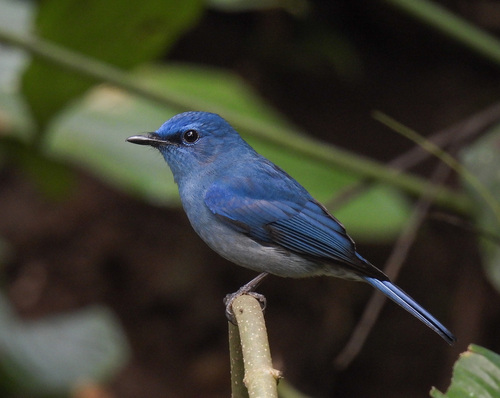 Pale Blue FlycatcherCyornis unicolorThe pale blue flycatcher is a bird in the family Muscicapidae.
 Hill Blue FlycatcherCyornis whiteiThe hill blue flycatcher is a species of bird in the family Muscicapidae.
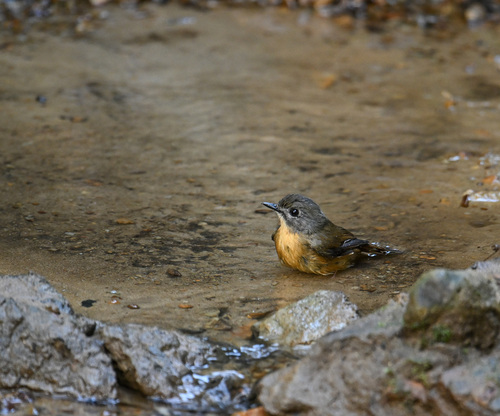 Pale-chinned FlycatcherCyornis poliogenysThe pale-chinned flycatcher is a species of bird in the family Muscicapidae.
Side by side: Blue-throated Blue Flycatcher vs White-bellied Blue Flycatcher
Learn the White-bellied Blue Flycatcher in the BeakBrain App
Photo and call practice. Coming soon to iPhone and Android.
Play today's Daily BirdEvery photo and recording on this page is credited to its author under the licence shown. Spotted a problem with this page, or have a better photo? Contribute.