Learn what every symbol on the card means.Full credits and sources at beakbrain.com/symbols
 ForestCup nestMedium · 210 g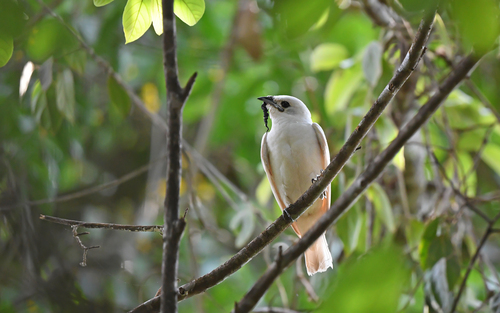


ID tip
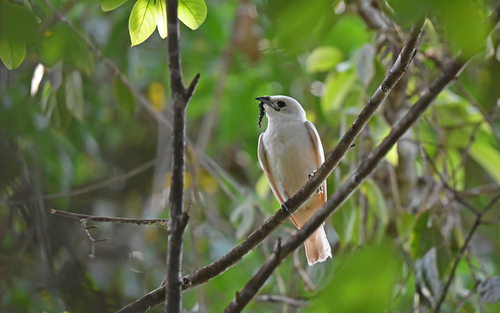
The white bellbird is about 27 to 29 cm (11 to 11 in) long; males weigh 210 to 222 g (7.4 to 7.8 oz). The species is dramatically sexually dimorphic though both sexes have a short bill that opens very wide. Males are unique. Females resemble female bearded bellbirds (P. averano). Adult males of the nominate subspecies have entirely white plumage. They have a single black wattle with a few white feathers that drapes from the base of the maxilla. Females do not have a wattle. Adult females have an olive-green head and upperparts. Voice: The white bellbird is believed to be the world's loudest bird, with calls of up to 125 dB(A) (at equivalent 1m distance). The record was previously held by the screaming piha, which was recorded at 116 dB. The white bellbird has two main vocalizations. One is "a loud kong-kay like two sharp blows on a cracked bell, given with the head held immobile".
Text from Wikipedia, licensed CC BY-SA 4.0.
When to see the White Bellbird
One bar for each month. Filled bars are the 10 months with records; pale bars are months with none. The wide bar is February, the month with the most records.
Where to see the White Bellbird
The map shades 5 countries with regular records. Everything unshaded has no records. Countries are listed below the map.
About the White Bellbird
The white bellbird is a species of bird in the family Cotingidae, the cotingas. It is found in Brazil, French Guiana, Guyana, Suriname, Venezuela, and as a vagrant to Trinidad.
Text adapted from Wikipedia, licensed CC BY-SA 4.0.
Easily confused with
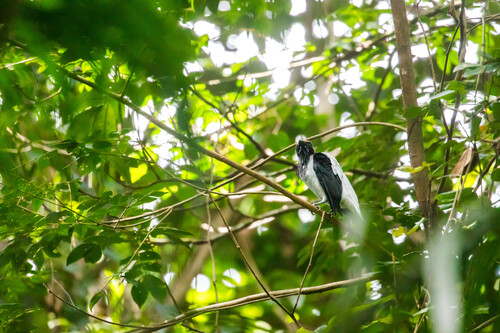 Bearded BellbirdProcnias averanoLike other cotingas, the bearded bellbird has a broad hooked-tipped bill, rounded wings, strong legs and a striking appearance.
 Three-wattled BellbirdProcnias tricarunculatusOne of four species of bellbird that live in Central and South America, the three-wattled bellbird is between 25 cm (9.8 in) and 30 cm (12 in) long.
 Bare-throated BellbirdProcnias nudicollisVoice: The male has one of the loudest calls of any bird—a sharp sound like that of a hammer striking an anvil or a bell.
Learn the White Bellbird in the BeakBrain App
Photo and call practice. Coming soon to iPhone and Android.
Play today's Daily BirdEvery photo and recording on this page is credited to its author under the licence shown. Spotted a problem with this page, or have a better photo? Contribute.