Learn what every symbol on the card means.Full credits and sources at beakbrain.com/symbols
 ForestMedium · 182 g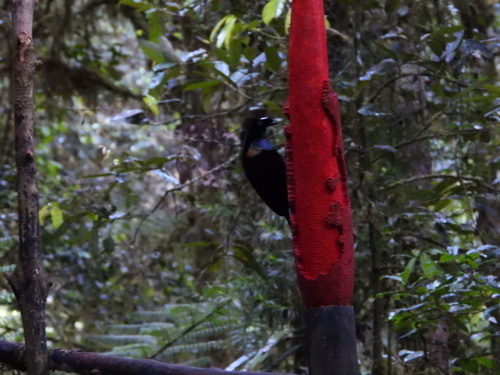
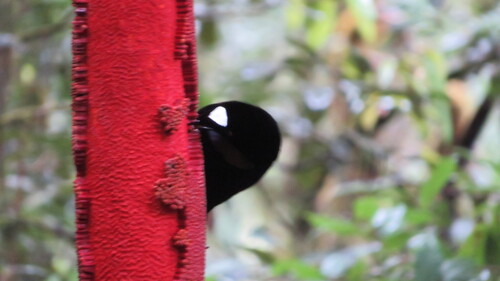



ID tip
Like other birds-of-paradise, the western parotia is sexually dimorphic. The male has jet black plumage, with striking iridescent scale-like golden-green breast shields and triangular silver feathers on its crown. The occipital plumes (or head wires) arise from above and behind the eyes, with three long erectile wire-like plumes with smaller spatulate tips, above and behind each eye. As with most members of the family, the female is unadorned and has brown plumage. The species is similar to Lawes's parotia (Parotia lawesii).
Text from Wikipedia, licensed CC BY-SA 4.0.
When to see the Western Parotia
One bar for each month. Filled bars are the 7 months with records; pale bars are months with none. The wide bar is July, the month with the most records.
Where to see the Western Parotia
The map shades 2 countries with regular records. Everything unshaded has no records. Countries are listed below the map.
About the Western Parotia
The western or Arfak parotia is a medium-sized, approximately 33 cm long, bird-of-paradise with a medium-length tail.
Text adapted from Wikipedia, licensed CC BY-SA 4.0.
Easily confused with
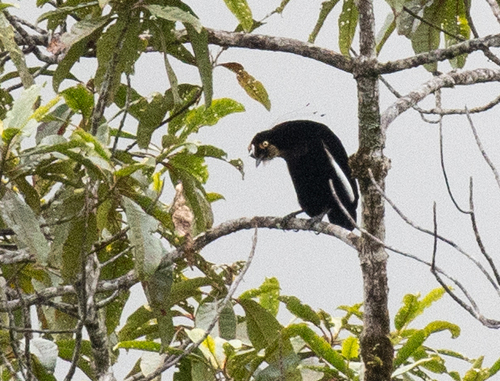 Queen Carola's ParotiaParotia carolaeCarola's parotia is medium-sized, up to 26 cm long.
 Lawes's ParotiaParotia lawesiiThe male is a velvet black bird with an erectile silvery white forehead crest, iridescent purple blue nape and golden green breast plumes which are structurally colored.
Wahnes's ParotiaParotia wahnesiThe male has an iridescent yellow-green breast shield, elongated black plumes, three erectile spatule head wires behind each eye, coppery-bronzed nasal tuft feathers and long, wedge-shaped tail feathers.
Lawes's ParotiaParotia lawesiiThe male is a velvet black bird with an erectile silvery white forehead crest, iridescent purple blue nape and golden green breast plumes which are structurally colored.
Wahnes's ParotiaParotia wahnesiThe male has an iridescent yellow-green breast shield, elongated black plumes, three erectile spatule head wires behind each eye, coppery-bronzed nasal tuft feathers and long, wedge-shaped tail feathers.
Learn the Western Parotia in the BeakBrain App
Photo and call practice. Coming soon to iPhone and Android.
Play today's Daily BirdEvery photo and recording on this page is credited to its author under the licence shown. Spotted a problem with this page, or have a better photo? Contribute.