Learn what every symbol on the card means.Full credits and sources at beakbrain.com/symbols
 Urban22 g


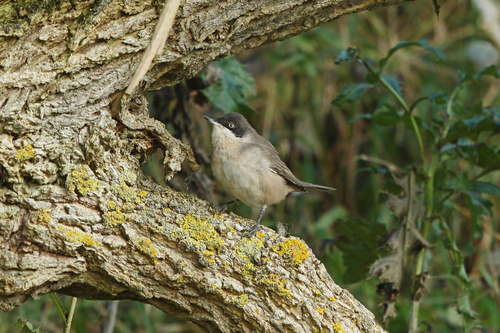
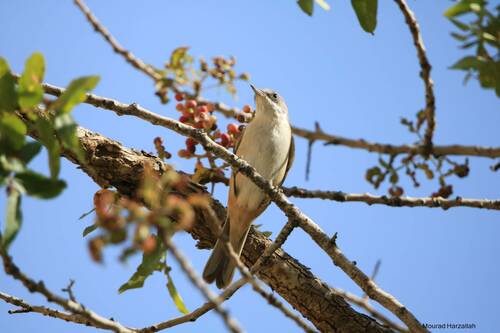
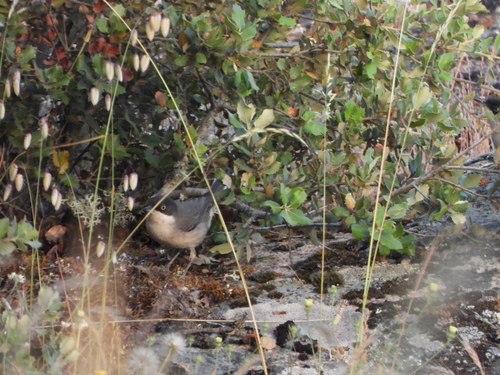
What the Western Orphean Warbler sounds like


ID tip
At 15–16 centimetres (6–6+1⁄4 in) in length – somewhat larger than a blackcap – this is one of the largest species of typical warblers. The adult males have a plain grey back and whitish underparts. The bill is long and pointed and the legs black. The male has a dark grey head, black eye mask, and white throat. The iris is white. Females and immatures have a paler head and buff underparts; their grey back has a brownish tinge. The iris is dark in young birds. The song is a series of warbling liroo-liroo and scolding notes.
Text from Wikipedia, licensed CC BY-SA 4.0.
When to see the Western Orphean Warbler
One bar for each month. Filled bars are the 5 months with records; pale bars are months with none. The wide bar is May, the month with the most records.
Where to see the Western Orphean Warbler
The map shades 16 countries with regular records, and 10 more in a lighter tone where the bird turns up only as a stray. Everything unshaded has no records. Countries are listed below the map.
Recorded as a rare visitor in United Kingdom, Belgium, Germany, Türkiye, Israel, Switzerland, Netherlands, Chad, Cyprus, Malta.
About the Western Orphean Warbler
The western Orphean warbler is an Old World warbler of the genus Curruca. This species occurs in summer around the Mediterranean, through western Europe and extending into northwest Africa. It is migratory, wintering in Sub-Saharan Africa. It is a rare vagrant to northern and north-western Europe.
Text adapted from Wikipedia, licensed CC BY-SA 4.0.
Easily confused with
 Spectacled WarblerCurruca conspicillataThe spectacled warbler is a species of passerine bird in the warbler genus Curruca in the family Sylviidae.
 Eastern Orphean WarblerCurruca crassirostrisThe eastern Orphean warbler is an Old World warbler of the genus Curruca.
 Barred WarblerCurruca nisoriaThe barred warbler is a species of bird in the warbler family Sylviidae which breeds across temperate regions of central and eastern Europe and western and central Asia.
Side by side: Dartford Warbler vs Western Orphean Warbler
Learn the Western Orphean Warbler in the BeakBrain App
Photo and call practice. Coming soon to iPhone and Android.
Play today's Daily BirdEvery photo and recording on this page is credited to its author under the licence shown. Spotted a problem with this page, or have a better photo? Contribute.