Learn what every symbol on the card means.Full credits and sources at beakbrain.com/symbols
 ForestDomed nestSmall · 21 g


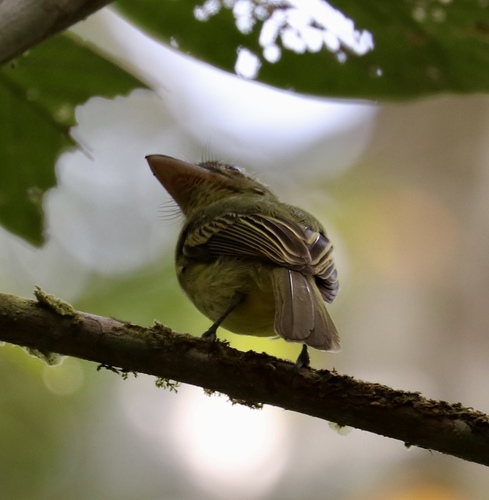
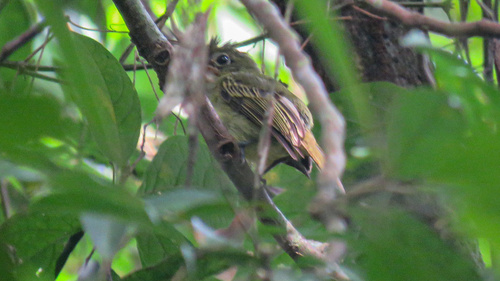
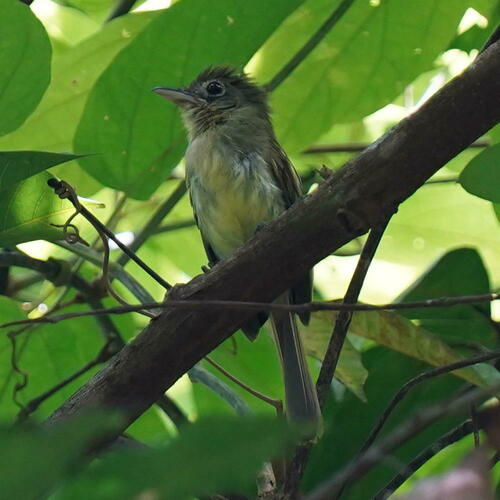
ID tip
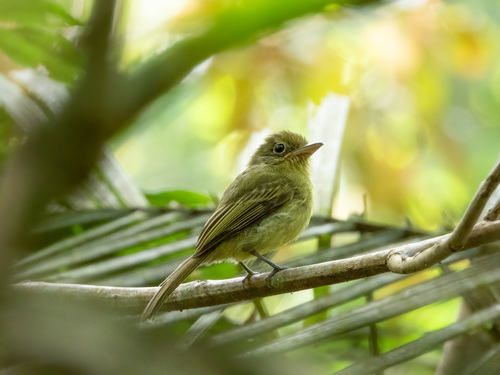
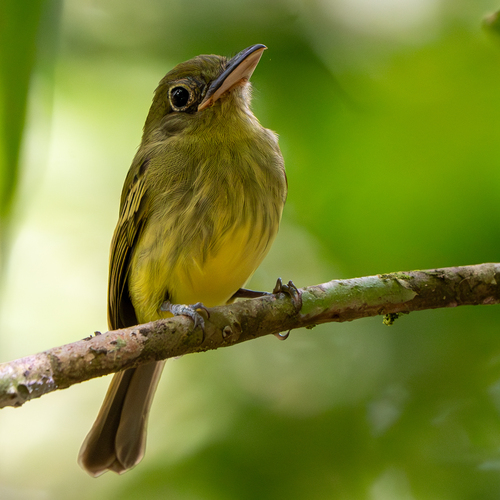
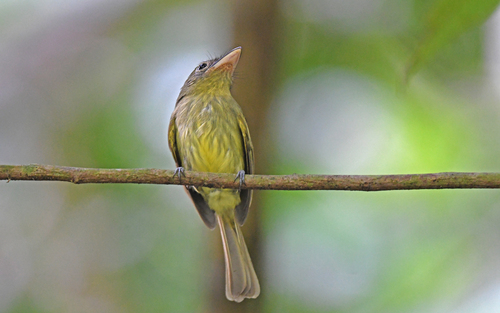
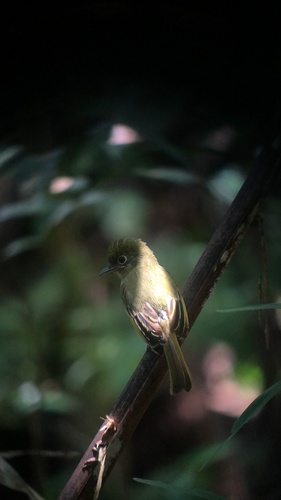
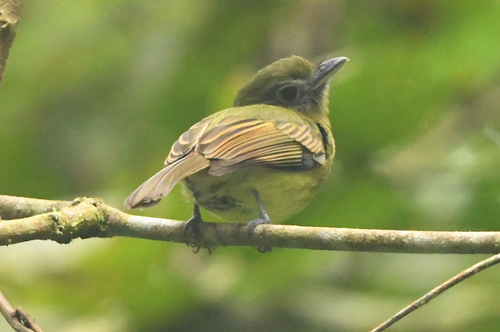
The western olivaceous flatbill is 13.5 to 15 cm (5.3 to 5.9 in) long and weighs 14 to 24.5 g (0.49 to 0.86 oz). The sexes have the same plumage. Adults of the nominate subspecies R. a. aequinoctialis have a dark olive head with a somewhat indistinct white eye-ring. Their entire upperparts are dark olive. Their wings are dusky with yellowish edges on the wing coverts and secondaries that form two dull wing bars. Their tertials have buffy to yellow edges. Their tail is a dusky with paler outer edges on the feathers. Voice: Researchers have identified three vocalizations of the western olivaceous flatbill. Its song is a "series of typically 5-10 whistles, initially flat and buzzy, gradually shifting to louder purer whistles which accelerate and rise in pitch" and which sometimes are followed by a series of stutters.
Text from Wikipedia, licensed CC BY-SA 4.0.
When to see the Western Olivaceous Flatbill
One bar for each month, and every month is filled: this bird is recorded here in all twelve. The wide bar is March, the month with the most records.
Where to see the Western Olivaceous Flatbill
The map shades 6 countries with regular records, and 1 more in a lighter tone where the bird turns up only as a stray. Everything unshaded has no records. Countries are listed below the map.
Recorded as a rare visitor in Brazil.
About the Western Olivaceous Flatbill
The western olivaceous flatbill is a species of bird in the family Tyrannidae, the tyrant flycatchers. It is found in Bolivia, Brazil, Colombia, Ecuador, Panama, Peru, and Venezuela.
Text adapted from Wikipedia, licensed CC BY-SA 4.0.
Easily confused with
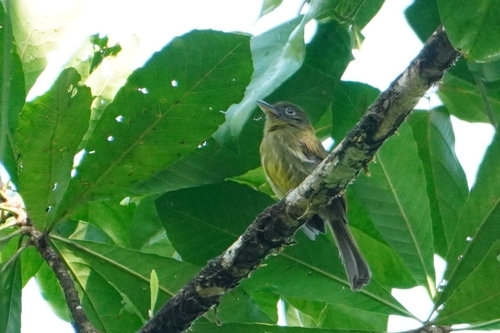 Pacific FlatbillRhynchocyclus pacificusThe Pacific flatbill is about 15 cm (5.9 in) long and weighs 23.5 to 26.5 g (0.83 to 0.93 oz).
 Fulvous-breasted FlatbillRhynchocyclus fulvipectusThe fulvous-breasted flatbill is about 15 cm (5.9 in) long and weighs 11.4 to 27.5 g (0.40 to 0.97 oz).
 Eastern Olivaceous FlatbillRhynchocyclus olivaceusThe eastern olivaceous flatbill is about 15 cm (5.9 in) long and weighs 18 to 24.8 g (0.63 to 0.87 oz).
Learn the Western Olivaceous Flatbill in the BeakBrain App
Photo and call practice. Coming soon to iPhone and Android.
Play today's Daily BirdEvery photo and recording on this page is credited to its author under the licence shown. Spotted a problem with this page, or have a better photo? Contribute.