Learn what every symbol on the card means.Full credits and sources at beakbrain.com/symbols
 GrasslandDomed nestMedium · 100 g


What the Western Meadowlark sounds like


ID tip
Western meadowlark adults have yellow underparts with a black "V" on the breast and white flanks streaked with black. Their upper parts are mostly brown, but also have black streaks. These birds have long, pointed bills and their heads are striped with light brown and black bands. Measurements: Length: 16–26 cm (6.3–10.2 in) Wingspan: 41 cm (16 in) Weight: 89–115 g (3.1–4.1 oz) These birds have a flute-like warbled song. These calls contrast with the simple, whistled call of the eastern meadowlark.
Text from Wikipedia, licensed CC BY-SA 4.0.
When to see the Western Meadowlark
One bar for each month. Filled bars are the 11 months with records; pale bars are months with none. The wide bar is May, the month with the most records.
Where to see the Western Meadowlark
The map shades 3 countries with regular records. Everything unshaded has no records. Countries are listed below the map.
About the Western Meadowlark
The western meadowlark is a medium-sized icterid bird, about 20 cm (7.9 in) in length. It is found across western and central North America and is a partial migrant, breeding in western Canada and western United States west of the Great Lakes, and in northern Mexico. In the northern half of the breeding range, the birds migrate south for the winter, while further south they are resident all year. The winter range also extends south and southeast of the breeding range, as far as central Mexico, and east to western Florida. The western meadowlark nests on the ground in open grasslands and shrublands. It feeds on bugs and seeds.
Text adapted from Wikipedia, licensed CC BY-SA 4.0.
Easily confused with
 Eastern MeadowlarkSturnella magnaThe adult eastern meadowlark measures from 19 to 28 cm (7.5 to 11.0 in) in length and spans 35–40 cm (14–16 in) across the wings.
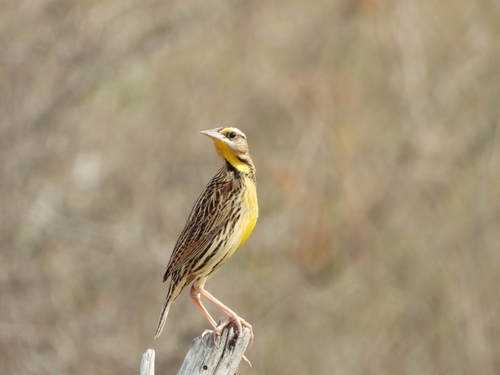 Chihuahuan MeadowlarkSturnella lilianaeThe Chihuahuan meadowlark is about 25 cm (9.8 in) long.
Side by side: Eastern Meadowlark vs Western Meadowlark · Chihuahuan Meadowlark vs Western Meadowlark
Learn the Western Meadowlark in the BeakBrain App
Photo and call practice. Coming soon to iPhone and Android.
Play today's Daily BirdEvery photo and recording on this page is credited to its author under the licence shown. Spotted a problem with this page, or have a better photo? Contribute.