Learn what every symbol on the card means.Full credits and sources at beakbrain.com/symbols
 ForestCavity nestMedium · 77 g



ID tip
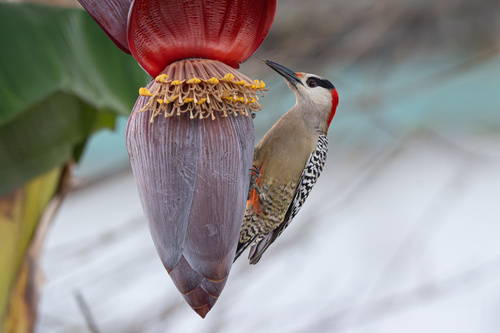
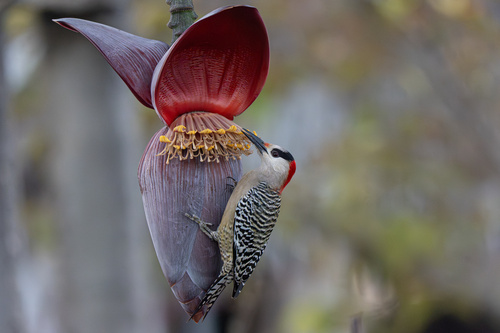
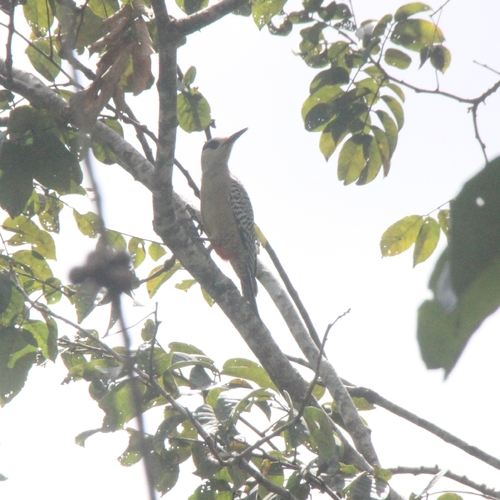
The West Indian woodpecker is about 27 to 32 cm (11 to 13 in) long and weighs 48 to 126 g (1.7 to 4.4 oz). Individuals on large islands are larger than those on small islands, and males are generally heavier and slightly larger than females. Males and females have the same plumage except for the pattern on their heads. Adult males of the nominate subspecies M. s. superciliaris have a red crown, nape, and hindneck and a black supercilium that extends to the red. Adult females have a whitish crown and the black supercilium entends around to separate the crown from the red nape.
Text from Wikipedia, licensed CC BY-SA 4.0.
When to see the West Indian Woodpecker
One bar for each month. Filled bars are the 10 months with records; pale bars are months with none. The wide bar is March, the month with the most records.
Where to see the West Indian Woodpecker
The map shades 3 countries with regular records. Everything unshaded has no records. Countries are listed below the map.
About the West Indian Woodpecker
The West Indian woodpecker is a species of bird in subfamily Picinae of the woodpecker family Picidae. It is found in the Bahamas, the Cayman Islands and Cuba.
Text adapted from Wikipedia, licensed CC BY-SA 4.0.
Easily confused with
 Hispaniolan WoodpeckerMelanerpes striatusThe Hispaniolan woodpecker is a gold and black barred bird growing to a length of from 22 to 28 cm (8.7 to 11.0 in).
 White-fronted WoodpeckerMelanerpes cactorumThe adult white-fronted woodpecker is about 17 cm (7 in) in length.
 Yucatan WoodpeckerMelanerpes pygmaeusThe adult Yucatan woodpecker is 17 cm (6.7 in) in length.
Side by side: West Indian Woodpecker vs Yucatan Woodpecker · Hispaniolan Woodpecker vs West Indian Woodpecker · West Indian Woodpecker vs White-fronted Woodpecker · West Indian Woodpecker vs Yellow-fronted Woodpecker
Learn the West Indian Woodpecker in the BeakBrain App
Photo and call practice. Coming soon to iPhone and Android.
Play today's Daily BirdEvery photo and recording on this page is credited to its author under the licence shown. Spotted a problem with this page, or have a better photo? Contribute.