Learn what every symbol on the card means.Full credits and sources at beakbrain.com/symbols
 MarineScrapeHuge · 3.4 kg


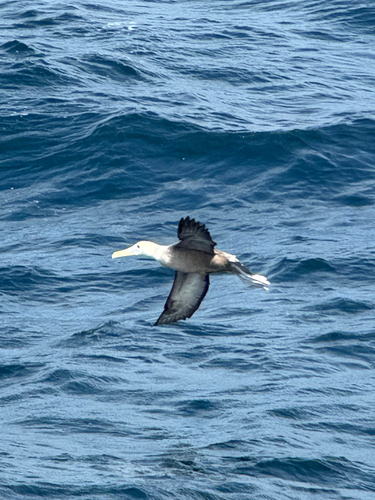


ID tip
These are medium-sized albatrosses, measuring 80 to 90 cm (31 to 35 in) in length with a wingspan of 220–250 cm (7.2–8.2 ft). They range between 2.7 and 4.0 kg (6.0 and 8.8 lb) in mass, with males averaging significantly heavier than females. They are distinctive for their yellowish-cream neck and head, which contrasts with their mostly brownish bodies. Even more distinctive is the very long, bright yellow bill, which looks disproportionately large in comparison to the relatively small head and long, slender neck.
Text from Wikipedia, licensed CC BY-SA 4.0.
When to see the Waved Albatross
One bar for each month. Filled bars are the 10 months with records; pale bars are months with none. The wide bar is July, the month with the most records.
Where to see the Waved Albatross
The map shades 3 countries with regular records, and 2 more in a lighter tone where the bird turns up only as a stray. Everything unshaded has no records. Countries are listed below the map.
Recorded as a rare visitor in Colombia, Costa Rica.
About the Waved Albatross
The waved albatross, also known as Galapagos albatross, is one of three species of the family Diomedeidae that occur in the tropics. When they forage, they follow a straight path to a single site off the coast of Peru, about 1,000 km (620 mi) to the east. During the non-breeding season, these birds reside primarily on the Ecuadorian and Peruvian coasts.
Text adapted from Wikipedia, licensed CC BY-SA 4.0.
Easily confused with
 Short-tailed AlbatrossPhoebastria albatrusThe short-tailed albatross is a medium-sized albatross, with a wingspan of 213 to 240 cm (6.99–7.87 ft), a length of 84 to 94 cm (33–37 in) and a body weight that can be 4.3 to 8.5 kg (9.5–18.7 lb).
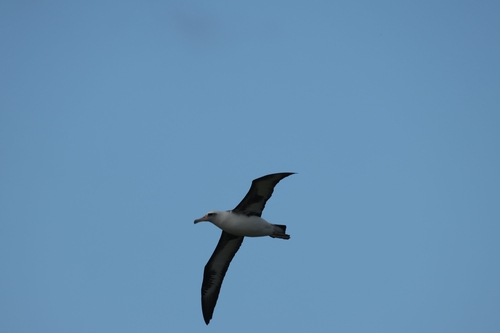 Laysan AlbatrossPhoebastria immutabilisThe Laysan albatross averages 81 cm (32 in) in length and has a wingspan of 195 to 203 cm (77–80 in).
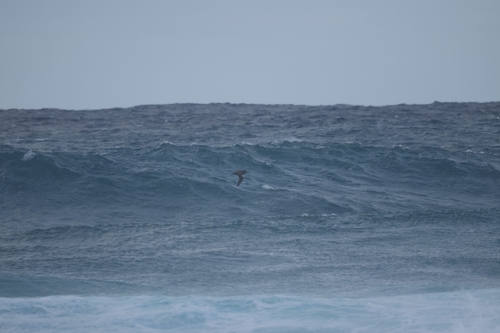 Black-footed AlbatrossPhoebastria nigripesThe black-footed albatross is a small member of the albatross family (while still large compared to most other seabirds) that has almost all black plumage.
Side by side: Black-footed Albatross vs Waved Albatross · Laysan Albatross vs Waved Albatross
Learn the Waved Albatross in the BeakBrain App
Photo and call practice. Coming soon to iPhone and Android.
Play today's Daily BirdEvery photo and recording on this page is credited to its author under the licence shown. Spotted a problem with this page, or have a better photo? Contribute.