Learn what every symbol on the card means.Full credits and sources at beakbrain.com/symbols
 WetlandScrapeMedium · 106 g


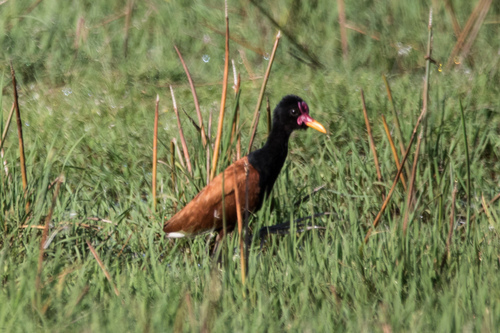
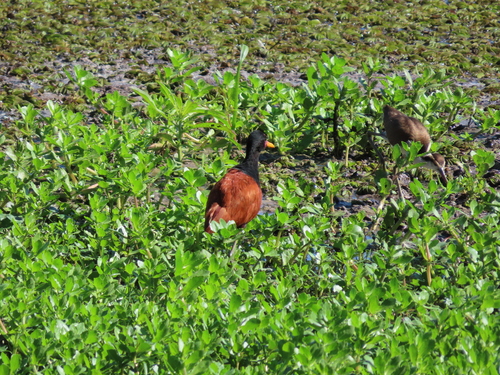
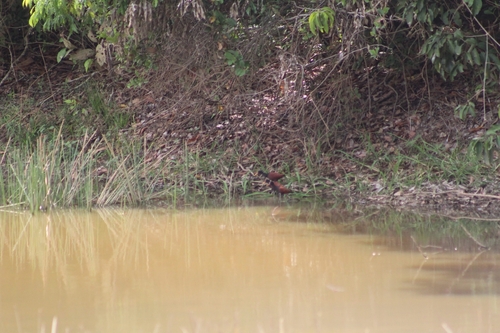
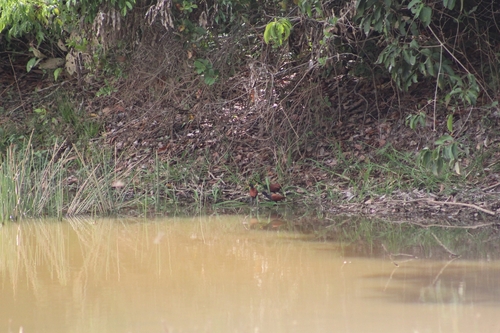
ID tip
These are conspicuous and unmistakable birds. They are 17–23 cm (6.7–9.1 in) long, but the females are larger than the males. The adults have a chestnut back and wing coverts, with the rest of the body mainly black. In flight the greenish yellow flight feathers are obvious. Also visible are yellow bony spurs on the leading edge of the wings, which it can use to defend itself and its young. The yellow bill extends up as a red coot-like head shield and a reddish wattle, and the legs and very long toes are dull blue-grey.
Text from Wikipedia, licensed CC BY-SA 4.0.
When to see the Wattled Jacana
One bar for each month, and every month is filled: this bird is recorded here in all twelve. The wide bar is October, the month with the most records.
Where to see the Wattled Jacana
The map shades 18 countries with regular records, and 2 more in a lighter tone where the bird turns up only as a stray. Everything unshaded has no records. Countries are listed below the map.
Recorded as a rare visitor in Chile, Antigua & Barbuda.
About the Wattled Jacana
The wattled jacana is a wader in the family Jacanidae found throughout much of South America east of the Andes, as well as western Panama and Trinidad. It is the only species in the Jacanidae family with such a large distribution. Wattled jacanas have long toes and claws which help them walk through aquatic vegetation. Like the majority of species of jacanas, the female is larger than the male, and forms harems of up to 4 or 5 males at any given time. There is also a major difference in proportional development or ornamentation and defense relative to body size when compared to males.
Text adapted from Wikipedia, licensed CC BY-SA 4.0.
Easily confused with

Side by side: Northern Jacana vs Wattled Jacana
Learn the Wattled Jacana in the BeakBrain App
Photo and call practice. Coming soon to iPhone and Android.
Play today's Daily BirdEvery photo and recording on this page is credited to its author under the licence shown. Spotted a problem with this page, or have a better photo? Contribute.