Learn what every symbol on the card means.Full credits and sources at beakbrain.com/symbols
 WetlandCup nestTiny · 8 g
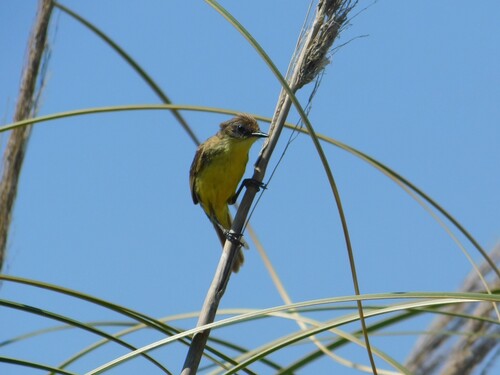
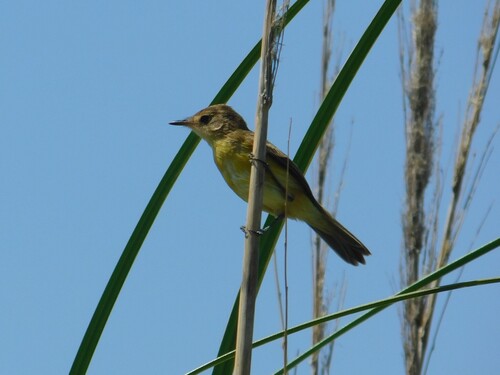
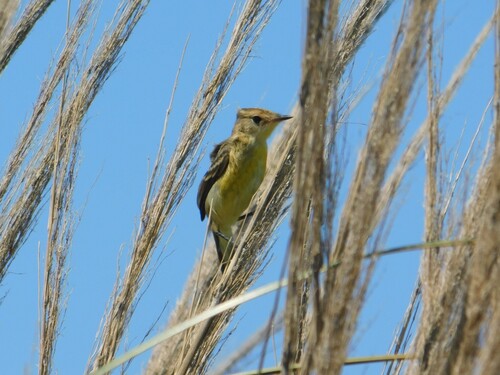
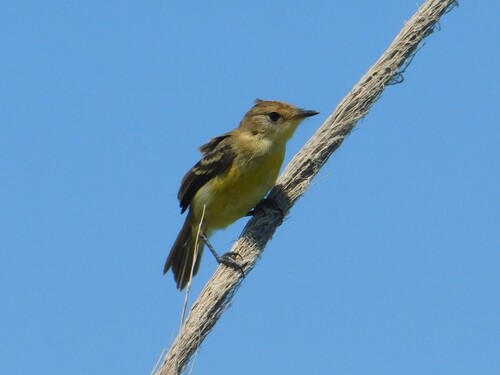
ID tip
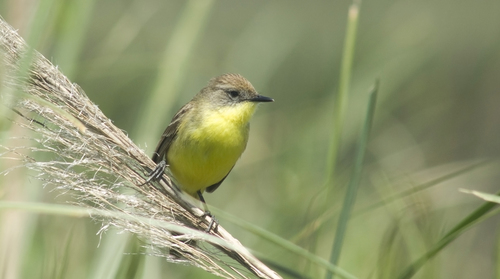
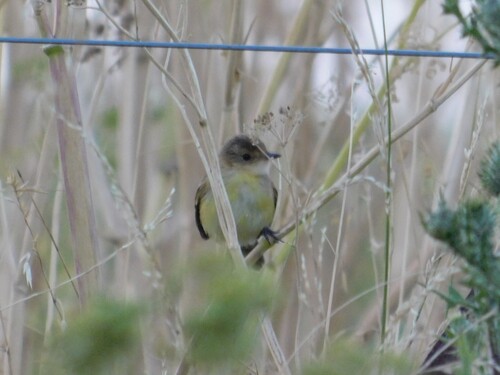
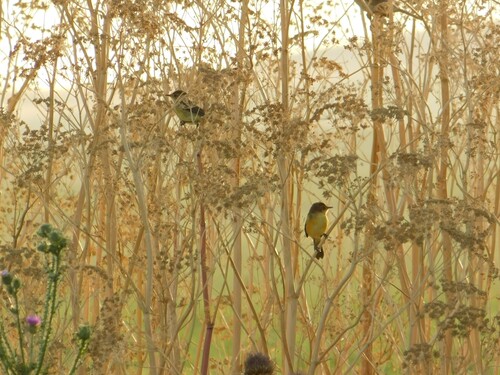
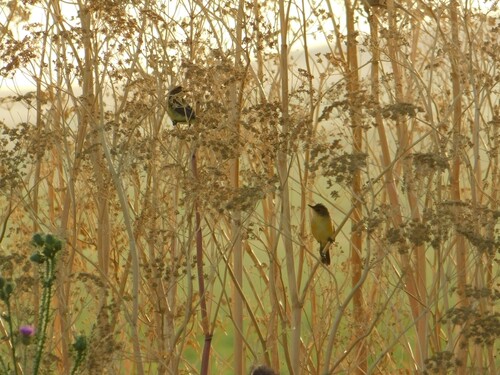
The warbling doradito is 11 to 12 cm (4.3 to 4.7 in) long and weighs 7 to 8 g (0.25 to 0.28 oz). The sexes have the same plumage. Adults have a mostly dull olive-brown head and upperparts. Their crown is rufescent, their lores and cheeks are dusky, and their tail is dusky olive-brown. Their wings are dull olive-brown with light buffy edges on the flight feathers and tips on the wing coverts; the last show as two faint wing bars. Their throat is bright yellow and their underparts a slightly less bright yellow. Both sexes have a medium brown iris and dark gray legs and feet. Voice: The warbling doradito's song is a "series of gentle and somewhat disjointed-sounding, high-pitched, staccato and squeaky notes, mechanical introduction followed by set of 4–8 more musical notes, 'chek, chek, chek, chek-chick-chick-chiquetik' or 'tk tk tk tk tk quít tuk péét tk-tuk, tk-quít' ", It makes "a 'tek' call while foraging".
Text from Wikipedia, licensed CC BY-SA 4.0.
When to see the Warbling Doradito
One bar for each month. Filled bars are the 8 months with records; pale bars are months with none. The wide bar is October, the month with the most records.
Where to see the Warbling Doradito
The map shades 4 countries with regular records. Everything unshaded has no records. Countries are listed below the map.
About the Warbling Doradito
The warbling doradito is a species of bird in subfamily Elaeniinae of family Tyrannidae, the tyrant flycatchers. It is found in Argentina, Paraguay, Uruguay and Brazil.
Text adapted from Wikipedia, licensed CC BY-SA 4.0.
Easily confused with
 Subtropical DoraditoPseudocolopteryx acutipennisThe subtropical doradito is 11 to 12 cm (4.3 to 4.7 in) long and weighs 7 to 10 g (0.25 to 0.35 oz).
 Crested DoraditoPseudocolopteryx sclateriThe crested doradito is 10 to 11 cm (3.9 to 4.3 in) long and weighs 6 to 9.9 g (0.21 to 0.35 oz).
 Ticking DoraditoPseudocolopteryx citreolaThe ticking doradito is about 12.5 cm (4.9 in) long and weighs 7.5 to 10 g (0.26 to 0.35 oz).
Learn the Warbling Doradito in the BeakBrain App
Photo and call practice. Coming soon to iPhone and Android.
Play today's Daily BirdEvery photo and recording on this page is credited to its author under the licence shown. Spotted a problem with this page, or have a better photo? Contribute.