Learn what every symbol on the card means.Full credits and sources at beakbrain.com/symbols
 ForestPlatform nestMedium · 119 g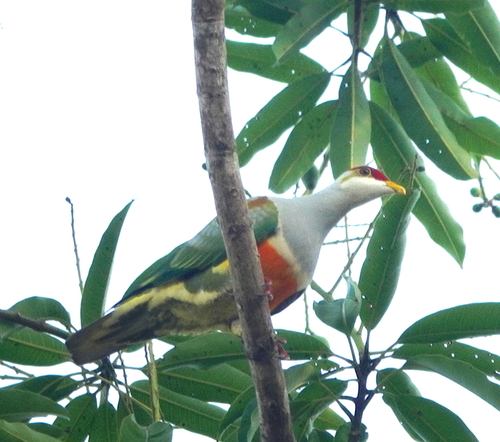
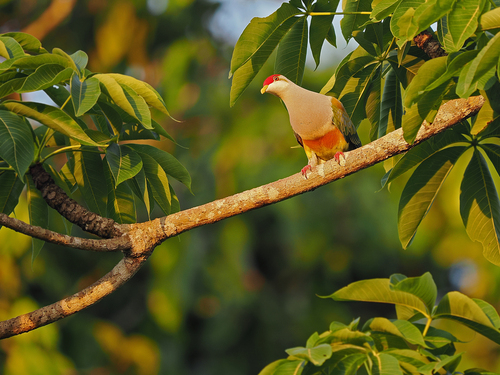
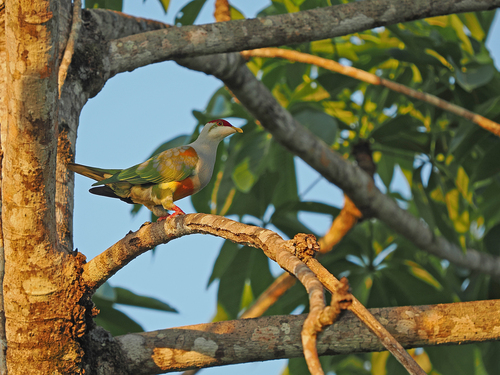

ID tip
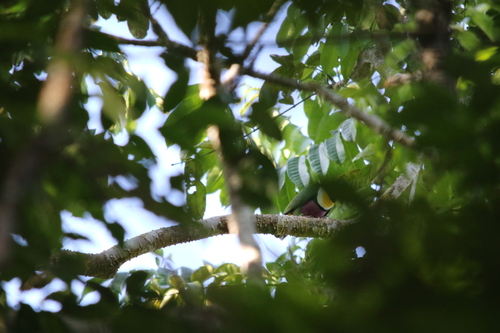
Wallace's fruit dove is a large, long-tailed fruit dove with a length of 24–28 cm (9.4–11.0 in). It has been described as "one of the most beautiful" fruit doves. The forehead and crown are dull crimson, sometimes extending to the back of the neck, and the lower face and throat are white. The rest of the head, neck, breast, and upper mantle are pale bluish-grey, separated from the orange belly patch by a white band. The shoulder patch is golden-bronze, while the mantle and inner wing coverts are bluish-grey with yellow edges that give a scaled appearance.
Text from Wikipedia, licensed CC BY-SA 4.0.
When to see the Wallace's Fruit Dove
One bar for each month. Filled bars are the 5 months with records; pale bars are months with none. The wide bar is October, the month with the most records.
Where to see the Wallace's Fruit Dove
The map shades 1 country with regular records. Everything unshaded has no records. Countries are listed below the map.
About the Wallace's Fruit Dove
Wallace's fruit dove is a species of a bird in the pigeon family Columbidae. The name commemorates the British naturalist Alfred Russel Wallace. It is a rather large, long-tailed fruit dove with a length of 24–28 cm (9.4–11.0 in) and has been described as "one of the most beautiful" fruit doves. The forehead and crown are dull crimson, the lower face and throat are white, and the rest of the head, breast, neck, and upper back are pale bluish-grey. The wings and lower back are green and the belly is orange, separated from the chest by a white band. Both sexes look similar, but females have less extensive red on the head and a greenish tinge to their grey parts.
Text adapted from Wikipedia, licensed CC BY-SA 4.0.
Easily confused with
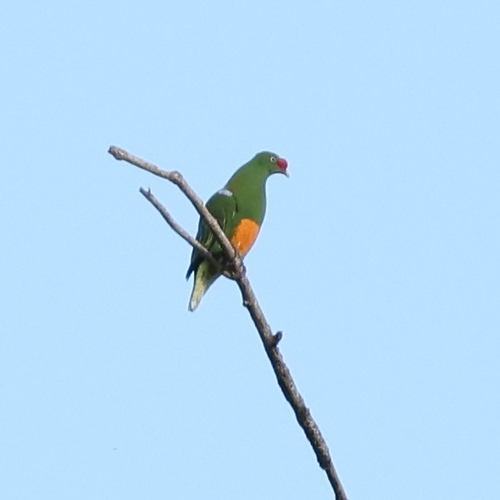 Knob-billed Fruit DovePtilinopus insolitusThe knob-billed fruit dove is a species of bird in the family Columbidae.
 Geelvink Fruit DovePtilinopus speciosusThe male has a dark green head and upperparts, a mauve belly, a bright yellow breast band bordered by white, and bold lime-yellow bare skin around the eyes.
 Yellow-bibbed Fruit DovePtilinopus solomonensisThe yellow-bibbed fruit dove or yellow-banded fruit dove is a species of bird in the family Columbidae.
Learn the Wallace's Fruit Dove in the BeakBrain App
Photo and call practice. Coming soon to iPhone and Android.
Play today's Daily BirdEvery photo and recording on this page is credited to its author under the licence shown. Spotted a problem with this page, or have a better photo? Contribute.