Learn what every symbol on the card means.Full credits and sources at beakbrain.com/symbols
 ForestMedium · 145 g


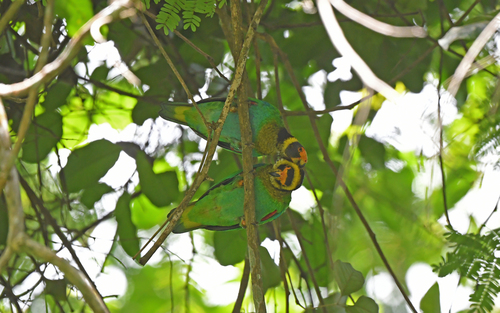
ID tip
The vulturine parrot is 23 to 25 cm (9.1 to 9.8 in) long and weighs 138 to 165 g (4.9 to 5.8 oz). The adult's face is mostly bare black skin, with yellowish lores and a collar of yellow feathers and a band of black feathers below that. Their upperparts are green with a reddish orange shoulder. Their breast is olive-yellow, their belly green with some blue edges to the feathers, and their lower thighs yellow. Their primaries are black with green edges and their carpal's edges and underwing coverts are red. Voice: The vulturine parrot's flight call is "a slightly nasal rhythmic "tree ... trayaweet" or simply "trayaweet"." It makes "a wide variety of calls, ranging from nasal yelps or barks to more melodious whistles and whining sounds, as well as more typically parrot-like calls" when perched.
Text from Wikipedia, licensed CC BY-SA 4.0.
When to see the Vulturine Parrot
One bar for each month. Filled bars are the 8 months with records; pale bars are months with none. The wide bar is August, the month with the most records.
Where to see the Vulturine Parrot
The map shades 1 country with regular records. Everything unshaded has no records. Countries are listed below the map.
About the Vulturine Parrot
The vulturine parrot is a species of bird in subfamily Arinae of the family Psittacidae, the African and New World parrots. It is endemic to Brazil.
Text adapted from Wikipedia, licensed CC BY-SA 4.0.
Easily confused with
 Caica ParrotPyrilia caicaThe caica parrot is 23 to 25 cm (9.1 to 9.8 in) long and weighs 121 to 143 g (4.3 to 5.0 oz).
 Saffron-headed ParrotPyrilia pyriliaThe saffron-headed parrot is 22 to 24 cm (8.7 to 9.4 in) long.
Learn the Vulturine Parrot in the BeakBrain App
Photo and call practice. Coming soon to iPhone and Android.
Play today's Daily BirdEvery photo and recording on this page is credited to its author under the licence shown. Spotted a problem with this page, or have a better photo? Contribute.