Learn what every symbol on the card means.Full credits and sources at beakbrain.com/symbols
 ForestCavity nestSmall · 30 g
What the Venezuelan Flycatcher sounds like

ID tip
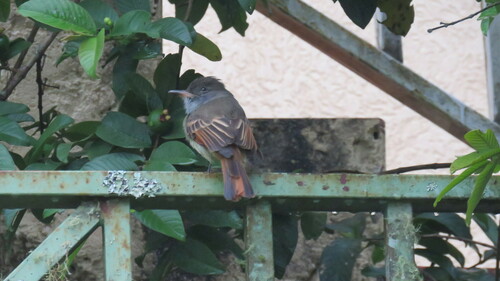
The Venezuelan flycatcher is 18 to 19 cm (7.1 to 7.5 in) long and weighs 27 to 33 g (0.95 to 1.2 oz). The sexes have the same plumage. Adults have a dark olive-green to brownish olive crown and upperparts. The crown has a slight crest and is slightly darker in the center, giving a streaked effect. Their lores are gray that extends to a short supercilium. Their cheeks are gray and their ear coverts brownish olive. Their wings are mostly dusky with thin rufous outer edges on the primaries. Voice: The Venezuelan flycatcher's dawn song is "a repeated of plaintive whistles (no huit notes)". Its day song is similar but not often heard. It also gives "repeated hiccup calls, rasps, rasp-whistles a whistled wheer-r-r".
Text from Wikipedia, licensed CC BY-SA 4.0.
When to see the Venezuelan Flycatcher
One bar for each month. Filled bars are the 10 months with records; pale bars are months with none. The wide bar is January, the month with the most records.
Where to see the Venezuelan Flycatcher
The map shades 3 countries with regular records. Everything unshaded has no records. Countries are listed below the map.
About the Venezuelan Flycatcher
The Venezuelan flycatcher is a passerine bird in the family Tyrannidae, the tyrant flycatchers. It is found in Colombia, Venezuela, and on Tobago.
Text adapted from Wikipedia, licensed CC BY-SA 4.0.
Easily confused with
 Lesser Antillean FlycatcherMyiarchus oberiThe Lesser Antillean flycatcher is 19 to 22 cm (7.5 to 8.7 in) long and weighs 21 to 37 g (0.74 to 1.3 oz).
 Rufous-tailed FlycatcherMyiarchus validusThe rufous-tailed flycatcher is a large flycatcher, about 24 cm (9.4 in) long and weighing about 39 to 43 g (1.4 to 1.5 oz).
 Grenada FlycatcherMyiarchus nugatorThe Grenada flycatcher is a large flycatcher, about 20 cm (7.9 in) long and weighing about 32 to 45 g (1.1 to 1.6 oz).
Learn the Venezuelan Flycatcher in the BeakBrain App
Photo and call practice. Coming soon to iPhone and Android.
Play today's Daily BirdEvery photo and recording on this page is credited to its author under the licence shown. Spotted a problem with this page, or have a better photo? Contribute.