Learn what every symbol on the card means.Full credits and sources at beakbrain.com/symbols
 ForestTiny · 19 g
ID tip
The Utcubamba tapaculo is small compared to other tapaculos; it is approximately 11 cm (4.3 in) long. Males weigh 16.7 to 22 g (0.59 to 0.78 oz) and females 14 to 20 g (0.49 to 0.71 oz). The male is entirely black. The female is dark gray above and somewhat lighter gray below with little of no brown on the flanks.
Text from Wikipedia, licensed CC BY-SA 4.0.
When to see the Utcubamba Tapaculo
One bar for each month. Filled bars are the 10 months with records; pale bars are months with none. The wide bar is October, the month with the most records.
Where to see the Utcubamba Tapaculo
The map shades 1 country with regular records. Everything unshaded has no records. Countries are listed below the map.
About the Utcubamba Tapaculo
The Utcubamba tapaculo is a species of bird in the family Rhinocryptidae that the South American Classification Committee of the American Ornithological Society split from blackish tapaculo in July 2020. It is endemic to Peru.
Text adapted from Wikipedia, licensed CC BY-SA 4.0.
Easily confused with
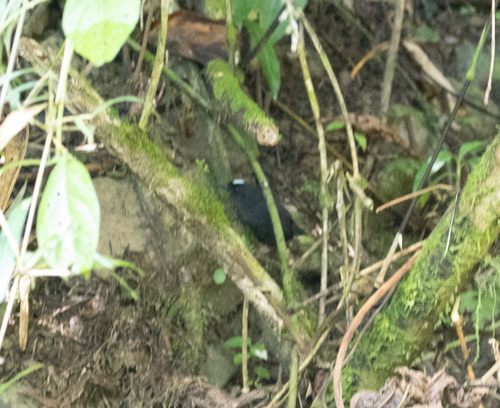 Bolivian TapaculoScytalopus bolivianusThe Bolivian tapaculo is 12 cm (4.7 in) long.
Unicolored TapaculoScytalopus unicolorThe unicolored tapaculo is 10.5 cm (4.1 in) long.
Bolivian TapaculoScytalopus bolivianusThe Bolivian tapaculo is 12 cm (4.7 in) long.
Unicolored TapaculoScytalopus unicolorThe unicolored tapaculo is 10.5 cm (4.1 in) long.
Learn the Utcubamba Tapaculo in the BeakBrain App
Photo and call practice. Coming soon to iPhone and Android.
Play today's Daily BirdEvery photo and recording on this page is credited to its author under the licence shown. Spotted a problem with this page, or have a better photo? Contribute.