Learn what every symbol on the card means.Full credits and sources at beakbrain.com/symbols
 GrasslandPlatform nestHuge · 2.9 kg


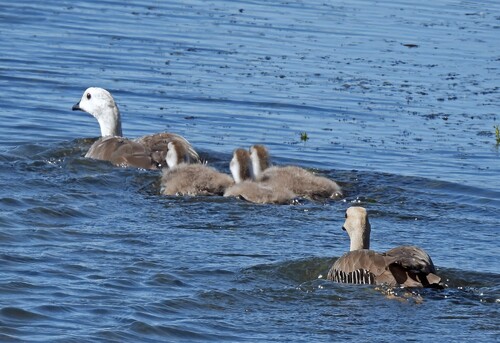
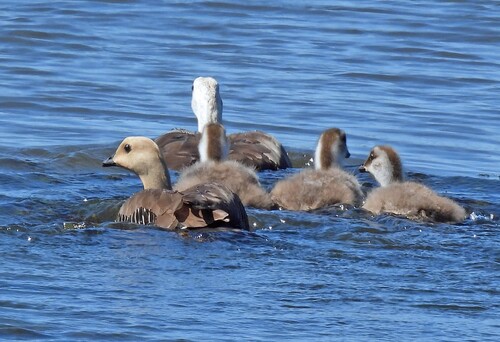


ID tip
Upland geese males are similar to other sheldgeese, notably the kelp goose (Chloephaga hybrida) due to their predominantly white plumage, while females resemble the ruddy-headed goose (C. rubidiceps) due to their similarly barred breast plumage. This species is 60–72.5 centimetres (23.6–28.5 in) long. Greater Magellan geese (leucoptera subspecies) are the largest birds of the genus Chloephaga. Males typically weigh 3.5–4.5 kg (7.7–9.9 lbs) and females range from 2.9 to 3.5 kg (6.4–7.7 lbs). Lesser Magellan geese (picta subspecies) males weigh 2.7–3.6 kg (6.0–7.9 lbs) on average and females 2.
Text from Wikipedia, licensed CC BY-SA 4.0.
When to see the Upland Goose
One bar for each month. Filled bars are the 11 months with records; pale bars are months with none. The wide bar is November, the month with the most records.
Where to see the Upland Goose
The map shades 6 countries with regular records, and 6 more in a lighter tone where the bird turns up only as a stray. Everything unshaded has no records. Countries are listed below the map.
Recorded as a rare visitor in Germany, France, United Kingdom, Netherlands, United States, Hungary.
About the Upland Goose
The upland goose or Magellan goose is a sheldgoose of the shelduck-sheldgoose subfamily of the Anatidae, the biological family that includes the ducks and most duck-like waterfowl such as the geese and swans. Sheldgeese resemble true geese and display similar habits, yet they are more closely related to shelducks and ducks.
Text adapted from Wikipedia, licensed CC BY-SA 4.0.
Easily confused with
 Andean GooseChloephaga melanopteraThe Andean goose is 70 to 76 cm (28 to 30 in) long and weighs 2.73 and 3.64 kg (6.0 and 8.0 lb).
 Ashy-headed GooseChloephaga poliocephalaThe ashy-headed goose is 50 to 60 cm (20 to 24 in) long.
 Kelp GooseChloephaga hybridaThe kelp goose is 55 to 65 cm (22 to 26 in) long.
Side by side: Coscoroba Swan vs Upland Goose · Musk Duck vs Upland Goose · Andean Goose vs Upland Goose · Ashy-headed Goose vs Upland Goose · Kelp Goose vs Upland Goose
Learn the Upland Goose in the BeakBrain App
Photo and call practice. Coming soon to iPhone and Android.
Play today's Daily BirdEvery photo and recording on this page is credited to its author under the licence shown. Spotted a problem with this page, or have a better photo? Contribute.