Learn what every symbol on the card means.Full credits and sources at beakbrain.com/symbols
 ForestCavity nestSmall · 50 g
What the Two-banded Puffbird sounds like


ID tip
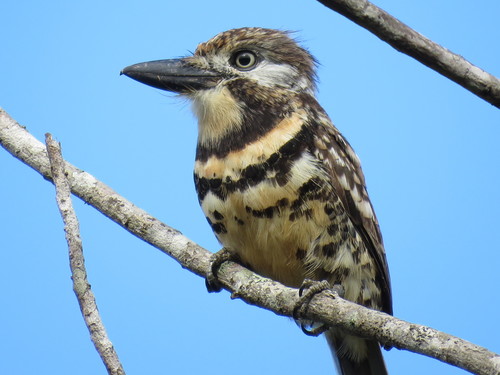
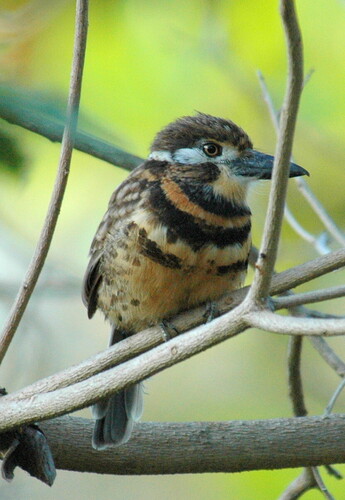
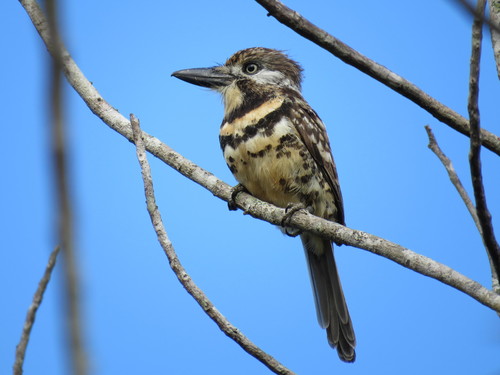
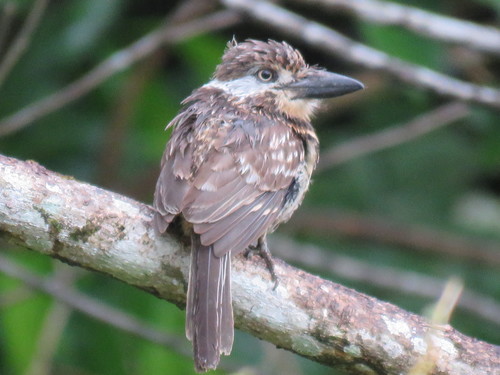
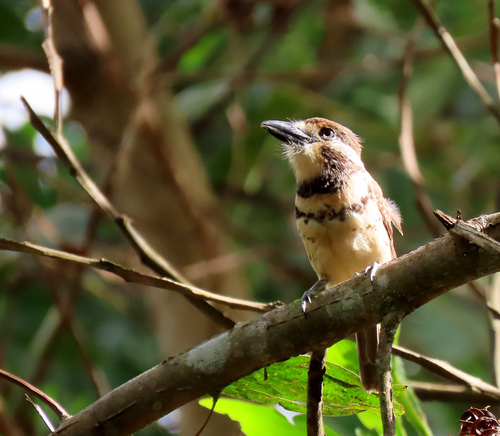
The adult of the nominate subspecies of two-banded puffbird has a dark brown crown with pale brown spots, a buffy patch from the bill to the eye, a whitish patch on the cheek, and a black patch below and behind the white one. The nape has a narrow whitish collar. The upperparts are dull brown with whitish mottling while the closed wing is dull brown with whitish scallops. The tail is long and dark brown with thin pale edges to the feathers. The chin is whitish and the throat and upper breast reddish buff. Under them are two black bands across the chest. Voice: The two-banded puffbird's song is "a rhythmic repeated 'tak-ta-tóoo'" and its call "a croaking note, surpisingly loud" that is sometimes given in flight.
Text from Wikipedia, licensed CC BY-SA 4.0.
When to see the Two-banded Puffbird
One bar for each month, and every month is filled: this bird is recorded here in all twelve. The wide bar is May, the month with the most records.
Where to see the Two-banded Puffbird
The map shades 2 countries with regular records. Everything unshaded has no records. Countries are listed below the map.
About the Two-banded Puffbird
The two-banded puffbird is a species of near-passerine bird in the family Bucconidae, the puffbirds, nunlets, and nunbirds. It is found in Colombia and Venezuela.
Text adapted from Wikipedia, licensed CC BY-SA 4.0.
Easily confused with

Side by side: Russet-throated Puffbird vs Two-banded Puffbird
Learn the Two-banded Puffbird in the BeakBrain App
Photo and call practice. Coming soon to iPhone and Android.
Play today's Daily BirdEvery photo and recording on this page is credited to its author under the licence shown. Spotted a problem with this page, or have a better photo? Contribute.